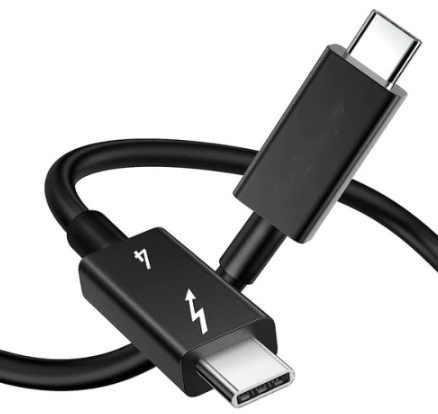
In today’s fast-paced digital world, USB4 and Thunderbolt 4 have become essential for improving work efficiency, entertainment experience, and multi-device connectivity. While both use the USB-C interface, they differ significantly in performance and features. Here’s a detailed guide to help you choose the interface that best suits your needs.
What is USB4?
USB4 (USB 4.0) is the latest USB standard, introduced by USB-IF in 2019. It uses the USB-C interface and supports tunneling protocols for data, video, and power delivery.
Key features include:
Mini-mum 20 Gbps data transfer speed, with some versions reaching 40 Gbps; USB4 2.0 can achieve 80 Gbps
Backward compatible with USB 3.2 / 3.0 / 2.0
Supports DisplayPort video output
Supports USB Power Delivery
Dynamic bandwidth sharing allows multiple devices to communicate over a single link
USB4 is based on the Thunderbolt 3 protocol, but full Thunderbolt support is not mandatory, so device performance may vary.
What is Thunderbolt 4?
Thunderbolt 4, launched in 2020, is Intel’s higher-standard, unified high-speed interface. It also uses USB-C but features stricter mini-mum requirements for performance and compatibility.
Key features include:
Stable 40 Gbps transfer speed (mandatory for all certified devices)
32 Gbps PCIe bandwidth, double the typical USB4 configuration
Supports dual 4K monitors or one 8K monitor
Enhanced security with DMA memory access protection
Supports up to six daisy-chained devices
Fully backward compatible with Thunderbolt 3 and USB4
Thunderbolt 4 devices are certified for stable performance and broad compatibility but usually cost more than standard USB4 products.
Similarities Between USB4 and Thunderbolt 4
Both use USB-C connectors
Maximum bandwidth up to 40 Gbps
Support DisplayPort video output
One cable can handle data, video, and power
Support wired network connections
Based on the Thunderbolt 3 protocol, offering a degree of interoperability
Differences Between USB4 and Thunderbolt 4
| Feature | USB 4.0 | Thunderbolt 4 |
| Transfer Speed | Minimum 20 Gbps, up to 40 Gbps | Stable 40 Gbps for all certified devices |
| Power Delivery | Up to 100W (depends on device) | Must support 100W |
| Multi-Display Support | Depends on device | Depends on deviceMust support dual 4K or single 8K |
| Compatibility | May not support TB3/TB4 | Fully compatible with USB4 and TB3 |
| Daisy-Chaining | Not guaranteed | Supports up to 6 devices |
| Security | No mandatory protection | Built-in DMA protection |
| Certification | No mandatory certification | Must be certified for performance |
Conclusion: USB4 or Thunderbolt 4?
Limited budget / general office use → choose USB4
Offers sufficient performance for most users and lower-priced hubs.
High-speed transfer, professional peripherals, multi-display → choose Thunderbolt 4
Ensures reliable bandwidth, enhanced video support, and stable performance under heavy load.
In general, Thunderbolt 4 provides stricter standards and a more consistent experience, making it ideal for high-performance needs. USB4, on the other hand, offers excellent compatibility and cost-effectiveness, suitable for everyday use. Always check product specifications to ensure interface compatibility with your devices.
If you want, I can also craft a SEO-friendly Meta Title, Meta Description, and H1/H2 suggestions for this article in English to boost its search visibility.
Do you want me to do that next?