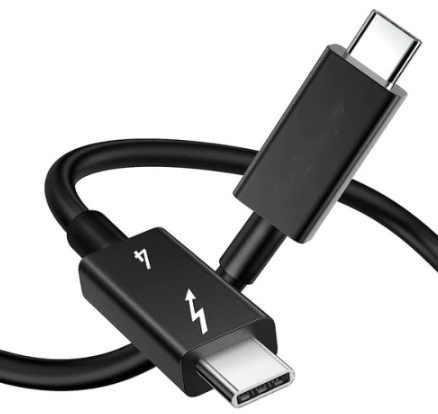
Since its inception in 1996, USB technology has been a cornerstone of modern computing, undergoing significant transformations from USB 1.0 to the high-speed USB 4. This series of technological upgrades has not only substantially increased data transfer speeds but also optimized power management and enhanced device compatibility. From USB 2.0 to USB 3.0, and then to USB 4, each iteration marks a significant leap forward, not only improving device interactions but also reshaping our digital lives.
Understanding the evolution of USB technology is crucial for making informed decisions when purchasing and using digital devices. This underscores the importance of recognizing the differences between different USB generations, as these disparities play a pivotal role in data transfer efficiency, device connectivity, and charging capabilities. Mastering the nuances of USB technology is essential for optimizing our interactions with digital technology.
USB 2.0: Pioneer of the High-Speed Era
USB 2.0, officially known as "High-Speed USB," represents a quantum leap compared to its predecessors, offering enhanced functionality and broader device compatibility. Introduced in April 2000, USB 2.0 was designed to meet the growing demand for higher data transfer speeds among USB peripherals such as external hard drives, printers, and digital cameras. Its maximum data transfer rate reaches up to 480 megabits per second (Mbps), a significant improvement over the 12 Mbps of the original USB 1.1 standard.
Although now surpassed by newer standards, USB 2.0 remains prevalent in a wide range of devices and applications. It not only increased data transfer rates but also enhanced power efficiency, boosting the power output of connected devices and enabling a broader range of peripherals to be powered directly from USB ports without the need for external power supplies. USB 2.0 remains highly relevant in many common applications and devices, such as keyboards, mice, and basic office printers, which do not require the high data transfer rates offered by USB 3.0 or USB 4. Additionally, USB 2.0 is still the primary choice for charging cables, flash drives for document storage, and audio interface connections, thanks to its widespread compatibility and sufficient speed for transferring small files or streaming audio data. The legacy of USB 2.0 lies in its balance of performance and broad compatibility, making it a key component in various technological applications.
USB 3.0: Ushering in the Ultra-High-Speed Era
USB 3.0, also known as "SuperSpeed USB," made its debut in 2008, marking a revolutionary stage in the development of Universal Serial Bus interfaces. In an era where the scale and complexity of digital content are rapidly growing, USB 3.0 was designed to meet the increasing demand for faster data transfer rates and enhanced power management.
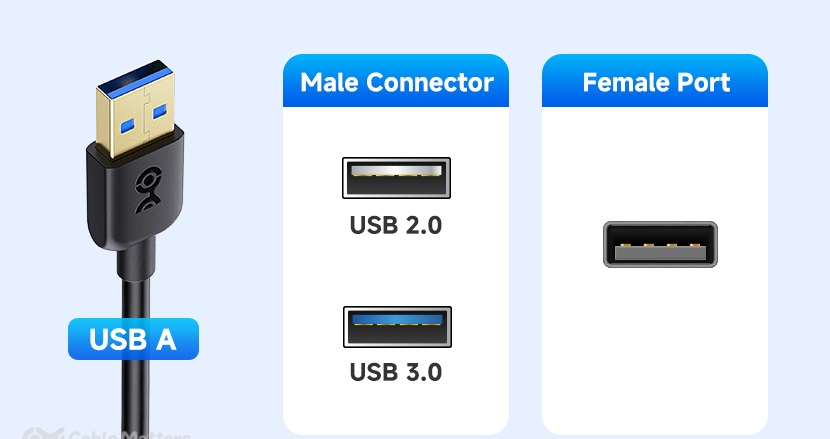
One of the most significant improvements of USB 3.0 is its theoretical data transfer rate of up to 5 gigabits per second (Gbps), more than ten times faster than USB 2.0. This speed leap is particularly beneficial for transferring large files such as high-definition videos, high-resolution photos, and large datasets. USB 3.0 achieves this speed by adding five pins to the USB 2.0 foundation, enabling full-duplex communication, which means it can send and receive data streams simultaneously.
The increase in bandwidth has significant practical implications. For example, it enables rapid file backups, reduces the time required to transfer videos from digital cameras, and improves system performance when using external solid-state drives (SSDs). Additionally, USB 3.0 has improved power delivery methods, providing more power to charging devices and enhancing energy efficiency, thereby accelerating the charging speed of smartphones and tablets. Moreover, USB 3.0 is backward compatible with USB 2.0 devices, allowing users to migrate to higher speeds without discarding old peripherals. However, to fully leverage the speed of USB 3.0, both the peripheral and the host need to be USB 3.0 compatible.
With these features, USB 3.0 has become the preferred choice for high-speed data transfer scenarios, such as video editing, high-performance gaming, and efficient data backup or large-scale data transfer tasks common in enterprise environments. Its introduction laid the foundation for subsequent faster and more powerful USB standards, including USB 3.1, 3.2, and eventually USB 4.
USB 3.2: Continuously Evolving High-Performance Interface
The development of USB 3.2 represents the ongoing evolution of USB interfaces, offering significant improvements in data transfer speeds and overall performance compared to USB 3.0. Introduced by the USB Implementers Forum (USB-IF) in 2017, USB 3.2 aims to meet the growing demand for faster and more efficient data transfer in the digital media sector.
A key advancement of USB 3.2 is the doubling of data rates compared to USB 3.1. USB 3.2 Gen 1x2 can theoretically provide data transfer speeds of up to 10 Gbps, while USB 3.2 Gen 2x2 offers an impressive 20 Gbps, four times the speed of USB 3.0. This improvement is partly due to multi-lane operation, where two high-speed USB lanes work in tandem to maximize data transfer speeds.
It's important to emphasize that to fully utilize the capabilities of USB 3.2, both the device and the host need to support the specific USB 3.2 standard. Although backward compatibility with older USB versions is retained, using older peripherals will not allow for the maximum potential speed of USB 3.2. In comparison, the later-introduced USB4 brings further improvements, with USB4 Gen 3x2 offering transfer speeds of up to 40 Gbps. However, USB 3.2 still provides robust performance for numerous applications that do not require ultra-high-speed transfers.
USB 3.2 has proven beneficial in use cases such as high-definition media streaming, real-time gaming, and rapid synchronization of massive data. Devices such as high-resolution webcams, video game consoles, and high-speed external SSDs frequently utilize USB 3.2 due to its combination of speed and versatility. USB 3.2 successfully combines high-speed data transfer with backward compatibility and high energy efficiency, setting a new benchmark for USB technology.
USB4: A Comprehensive Revolution in Connectivity Standards
USB4 represents the latest breakthrough in the development of Universal Serial Bus (USB) technology, setting significant milestones in speed, efficiency, and versatility. Officially launched in 2019, USB4 is not merely an incremental update but a comprehensive revolution that promises to redefine the capabilities of USB connections. Based on Thunderbolt 3 technology, USB4 offers significant improvements in data transfer rates, power delivery, and support for multiple data and display protocols.
Compared to its predecessors, USB4 achieves a significant leap in performance. While USB 2.0 has a maximum data transfer rate of 480 Mbps and USB 3.0 offers 5 Gbps, USB4's astonishing performance of up to 40 Gbps in compatible hardware far surpasses them. USB4 can dynamically allocate video and data bandwidth, further enhancing speed and making it ideal for simultaneously supporting high-resolution displays, rapid data transfers, and charging functions.
In addition to raw speed, USB4 also brings significant improvements in connectivity and compatibility. It adopts USB Type-C as the standard interface, ensuring a unified, reversible, and convenient connection. Furthermore, USB4's backward compatibility extends to USB 3.2, USB 2.0, and even Thunderbolt 3 devices, simplifying users' connection needs while providing broad compatibility.
The advantages of USB4 are multifaceted. Its increased speed and bandwidth are of great significance for data-intensive tasks such as video editing, high-definition gaming, and massive data backups. USB4's ability to simultaneously support multiple high-definition display protocols without compromising speed and efficiency is particularly important for professionals in the creative industries. Additionally, its improved power delivery standards promise faster charging speeds and better device power management, making USB4 a comprehensive solution for future connectivity needs.
In essence, USB4 sets a new benchmark for USB technology, offering unprecedented speed, exceptional connectivity, and enhanced compatibility. Its introduction heralds a future where data transfer and device interoperability will be more seamless and efficient than ever before.
Differences Between USB 2.0, USB 3.0, and USB4
Looking back at the evolution of Universal Serial Bus (USB) technology from USB 2.0 to USB 4, it's evident that each iteration has brought significant improvements in speed, compatibility, and applicability. USB 2.0, with a data transfer rate of up to 480 Mbps, laid the foundation for USB to become a universal connection standard for peripherals and devices. USB 3.0 marked a major leap forward, with speeds of up to 5 Gbps, signaling a trend towards higher efficiency and performance to meet the growing demand for rapid data transfer. USB 3.2 further expanded on this foundation, doubling the potential speed to 20 Gbps through multi-lane operation.
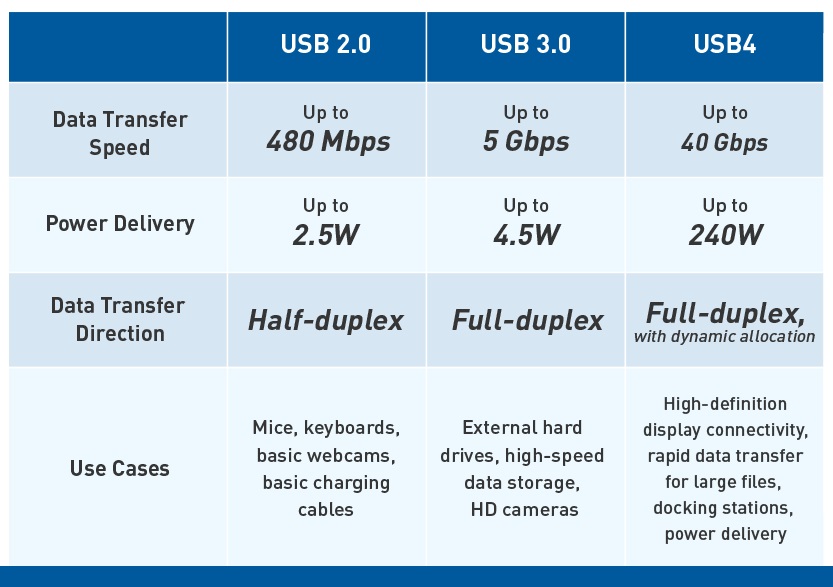
However, USB4 represents the pinnacle of this evolutionary journey so far. It integrates the high-speed capabilities of Thunderbolt 3 and adopts the USB Type-C universal connector standard. With speeds of up to 40 Gbps, dynamic bandwidth allocation for data and display, enhanced power delivery capabilities, and broad backward compatibility, USB4 meets the increasing demands of both consumer and professional markets for high bandwidth, versatility, and energy efficiency.
Looking ahead, as advancements continue in fields such as digital content creation, virtual reality, and high-definition video streaming, the demand for data speed and transfer capacity will continue to grow. USB technology is expected to keep evolving, with future versions potentially focusing on further increasing data transfer rates, enhancing power delivery capabilities, and improving universal compatibility. Innovations may include more efficient data encoding schemes, more robust power handling capabilities, and wireless USB applications. As the digital ecosystem becomes increasingly complex and data-intensive, the role of USB as a versatile, high-performance connectivity solution seems set to expand, driving progress in computing, communications, and consumer electronics.