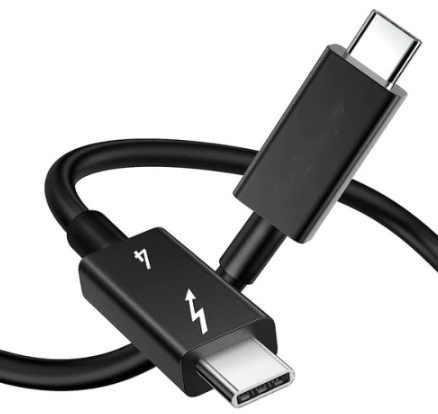
One cable can easily connect your MacBook to a multi-port laptop docking station, quickly connect multiple devices and expand displays, and instantly start a new experience of efficient office and entertainment. However, before choosing, we need to understand the port "language" of the MacBook.
Port rate secrets
Though Thunderbolt, USB4, and USB-C all use Type-C connectors, they differ significantly in data transfer rates and external display refresh rates. USB-C rates are 3Gbps or 10Gbps; USB4 increases to 20Gbps or 40Gbps; Thunderbolt 3 and 4 reach 40Gbps; Thunderbolt 5 is as high as 80Gbps/120Gbps. Check "What ports does my MacBook have" to see if your device is equipped with a USB-C port, or a Thunderbolt 3, 4, or 5 port.
For ordinary users, Thunderbolt 3 (TB3) docking stations are sufficient to meet daily needs; TB4 docking stations can be selected if the budget is sufficient; and Thunderbolt 5 docking stations are the best partners for high-end professionals. The docking station connects to and charges the laptop through the "upstream" Thunderbolt or USB-C port (the new MacBook also supports MagSafe 3 port power supply), and the "downstream" port is used for external hard drives, monitors and other devices.
External monitor: The magic of doubling the space
For users who use MacBook as their main device, connecting an external monitor with a keyboard and mouse to form a desktop/laptop hybrid configuration can greatly improve work efficiency. Whether it is expanding the 13-inch MacBook small screen into a 27-inch large screen, or connecting multiple monitors to cover the desktop, it can be easily achieved.
Mac natively supports USB-C interface, but only one external monitor can be connected in extended mode; Thunderbolt connection can achieve two or more extended screens. With the help of third-party software DisplayLink, some USB-C docking stations can even expand up to four screens on basic Macs.
Do you really need a docking station?
A MacBook equipped with a Max chip, three TB4 or TB5 and an HDMI port can connect to four external displays without a docking station. But heavy users still need a docking station to supplement ports to connect more devices.
The docking station is equipped with a rich interface, including both old-fashioned USB-A ports and powerful USB-C ports; the SD card reader built into the MacBook Pro is limited in speed, and choosing a docking station that supports the UHS-II standard can make memory card reading and writing faster. In addition, the MacBook does not support wired network ports. A docking station equipped with Gigabit Ethernet or a Thunderbolt to Ethernet adapter can help you get rid of the trouble of unstable Wi-Fi. Some new docking stations support 2.5Gb, 5Gb or even 10Gb Ethernet, bringing an extremely fast network experience.
Dock vs. Hub: Choose on Demand
If you only need a few extra ports, a USB-C hub or Thunderbolt hub will do; but if you need a lot of high-speed ports, Gigabit Ethernet ports, multiple video ports, and powerful charging capabilities, a full-featured dock is the only choice.
Charging power: Protecting the battery life of your MacBook
Different MacBook models have different charger power requirements: M1/M2/M3/M4 MacBook Air requires at least a 30W Power Delivery (PD) charger, and M2 and above Air can use an ultra-70W charger for fast charging; the 13-inch MacBook Pro requires a 67W charger, and the 14-inch and 16-inch MacBook Pro also have their own adapted power requirements. When purchasing a docking station, high-power MacBook Pro users should give priority to products with a PD power of at least 85W. 16-inch MacBook Pro users are more suitable for 240W chargers that support the PD 3.1 standard to achieve fast charging.
TB052 Thunderbolt 5 SSD Docking Station
This is one of the first Thunderbolt 5 docking stations, with plenty of fast USB ports, three certified 80Gbps Thunderbolt 5, and an additional internal SSD enclosure up to 4TB.
The TB052 offers flexible port configurations without having to replace the Thunderbolt 5 port with a dedicated DisplayPort or HDMI video port. You can use Thunderbolt to connect directly to a supported display, or add a video adapter for a DisplayPort or HDMI screen to connect an external display up to 6K.
If you have the right router, you can take advantage of the Echo 13's 2.5GbE Gigabit Ethernet to enjoy ultra-fast wired Internet access - 2.5 times faster than standard Gigabit Ethernet, and it also runs on a standard network.
> One upstream Thunderbolt 5 port (80Gbps, 140W)
> Two downstream Thunderbolt 5 ports (80Gbps, 1x 60W, 2x 15W)
> Three USB-A ports (10Gbps, 7.5W)
> Internal M.2 NVMe SSD enclosure
> Ethernet (2.5Gb)
> 140W power supply
DS018R Thunderbolt 4 Triple Display Docking Station
The DS018R Thunderbolt 4 Triple Display Docking Station is a bit of a misnomer for Mac users, as it can only connect two external 4K monitors in extended mode at 60Hz on a Mac. The third monitor can only mirror another monitor. This is a limitation of the Mac, not the DS018R.
Other than that, this dock is reasonably priced and fully functional. It sacrifices one of the three downstream TB4 ports for a single HDMI 2.1 port. One of those is for connecting one external monitor, and the other downstream TB4 port is for connecting another external monitor. The spare HDMI port can be used as a mirrored display, or as a third extended display on a Windows PC.
The USB ports are fast, as are the two card readers and the backward-compatible 2.5Gb Ethernet. Thunderbolt 4 allows data to be transferred to the laptop at 40Gbps.
The laptop draws 96W of power, which is more than enough for a 16-inch MacBook Pro. There's a convenient 30W USB-C charging port on the front, and it supports 10Gbps data transfer.
> One upstream Thunderbolt 4 port (40Gbps, 96W)
> Two downstream Thunderbolt 4 ports (40Gbps, 15W)
> One HDMI 2.1 video port (4K, 60Hz)
> One USB-C port (10Gbps, 30W)
> Three USB-A ports (10Gbps, 4.5W)
> Two USB-A ports (480Mbps, 4.5W)
> 2.5Gb Ethernet
> UHS-II SD card reader (312MBps)
> UHS-II MicroSD card reader (312MBps)
> 3.5mm audio jack
> 85W power supply