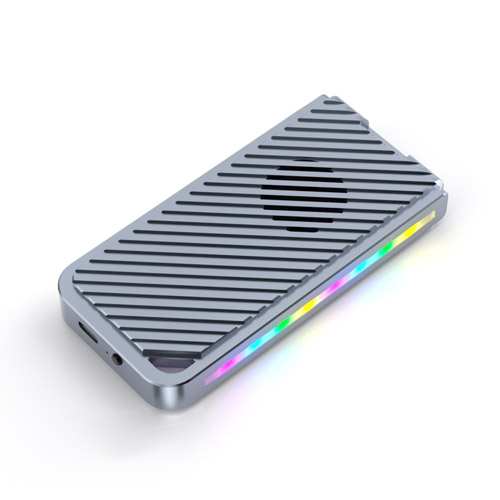
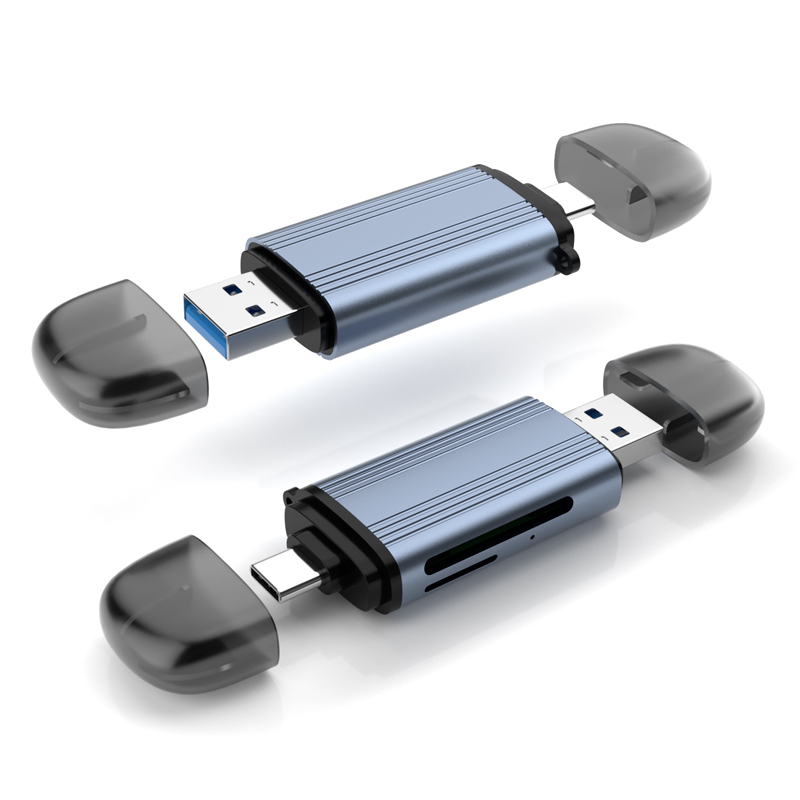
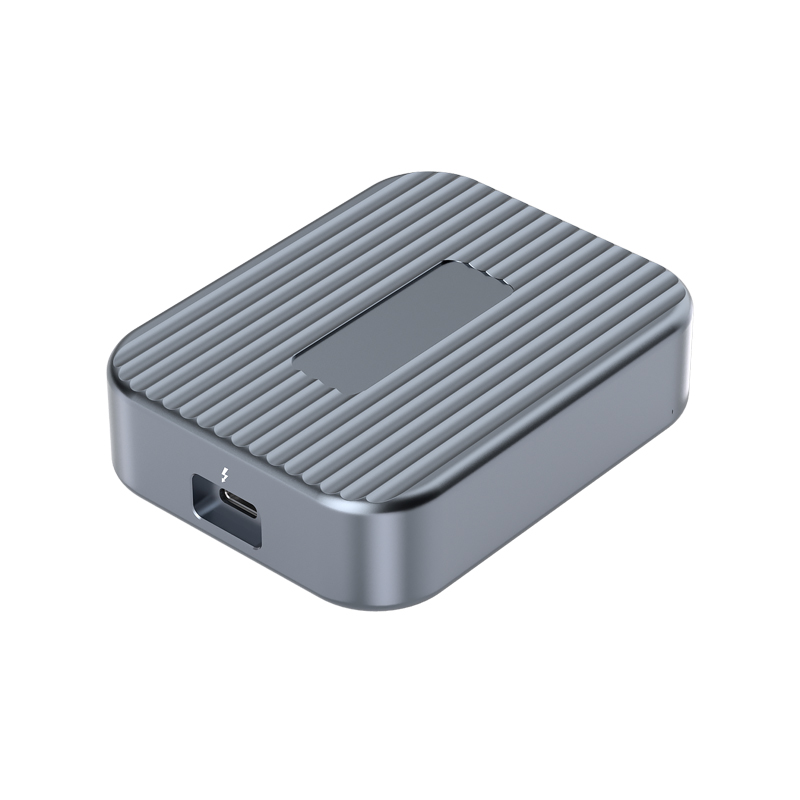
Internal storage drives are designed to connect to the SATA or M.2 ports inside your computer, but with a solid-state drive (SSD) or enclosure, you can turn them into portable backup devices that connect via USB. Whether you want to convert an old drive into external storage, buy a new SSD and convert it to an external drive, or plug it directly into a new SSD to clone your system, choosing the right enclosure is key.
Prices for SSDs or enclosures vary, ranging from $12 to $150, depending on the type of storage they contain and the connection speed you need. Most SSD enclosures focus on protecting the drive, cooling it, and converting the interface to USB, with some offering extra features like RGB lighting and status menus. To help you choose, we tested a dozen different models.
If you don't have an extra drive or don't want to install your internal drive in an enclosure, you can pick up a quality external SSD from the list we've tested. However, it's usually cheaper to buy an enclosure and install the drive yourself, and you can easily upgrade the drive to a higher capacity later without having to replace the enclosure.
So, how do you choose the right SSD/hard drive enclosure? Here are a few things to consider when choosing an SSD or hard drive enclosure:
Size fit
The SSD enclosure needs to match the physical size of the drive. A 2.5-inch hard drive or SSD requires a 2.5-inch SATA enclosure, and a 3.5-inch hard drive requires a 3.5-inch SATA enclosure. M.2 SSDs require an M.2 enclosure, and be careful if your SSD is shorter than the standard 2280 mm (80 mm), as most (but not all) enclosures have mounting screws that fit the shorter size, but there are exceptions. Also, if you're using an M.2 SATA SSD instead of an NVMe SSD, make sure the enclosure supports that standard (or both), as most M.2 enclosures only support NVMe.
Transfer speed
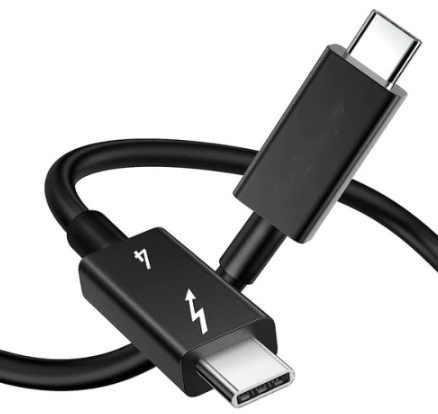
The transfer speed of the enclosure depends on its USB port and the USB ports on your computer. Most 2.5-inch and 3.5-inch hard drive/SSD enclosures run at standard 5 Gbps USB (USB 3/3.1 or 3.2 Gen 1); most M.2 SSD enclosures run at 10 Gbps (i.e. USB 3.1 or USB 3.2 Gen 2). Some higher-end models, priced over $130, can transfer at up to 40 Gbps, thanks to support for USB 4, Thunderbolt 3, or Thunderbolt 4 (all cross-compatible and running at 40 Gbps); some drives also support 20 Gbps USB, either USB 3.2 Gen 2x2 or USB 4 20 Gbps. For most users, 10 Gbps is more than enough. However, be aware that plugging a Thunderbolt enclosure into a port that doesn't support Thunderbolt may not work, and while USB 4 enclosures are theoretically backwards compatible with USB 3.x ports, in actual testing, we've seen incompatibilities.
Ease of opening and closing
Most of the M.2 SSD enclosures we tested are designed for one-time installation, where you install the hard drive, tighten the screws, and use it for a long time. If you plan to frequently change hard drives, a tool-free enclosure will be more convenient. Most M.2 enclosures on the market require a screwdriver to secure the cover and hard drive during installation, which is fine if you only need to install it once, but it is very troublesome if you need to do it repeatedly. The Purplelec PEC-M13 is a good choice for most users with its seamless tool-free design, affordable price, and stable 10 Gbps performance. It claims to support both SATA and NVMe drives, but since NVMe is the more common type of M.2 SSD and the type used in our testing, only the latter was tested.
Purplelec's PEC-M13 has the best tool-free design of all the cases we have tested. The top pops open with a push of the side button, and the cover folds back 180 degrees and remains attached to the gray aluminum chassis, making it much more practical than pluggable tool-free NVMe enclosures that require the cover to be completely slid open and are easily lost or installed in the wrong direction. In addition, the built-in thermal pad on the inside of the cover conducts the heat generated by the SSD to the metal chassis. In actual use, the PEC-M13 opens and closes easily without the need to press buttons.
After opening the chassis and sliding in the M.2 hard drive, the SSD can be firmly fixed by rotating the fixing fastener. The fixing fastener is suitable for 2280-size SSDs, and there are also rubber fasteners that can be inserted into the corresponding holes for 2260, 2242, and 2230-size SSDs.
In performance tests, the PEC-M13 performed well. Although the overall performance is a few percentage points lower than that of some pluggable hard drive enclosures, the gap is very small, and it even occasionally exceeds it. The DiskBench test shows that its read and write speeds are stable at 811 MBps and 538 MBps; in the CrystalDiskMark test, the 4K Q32 read and write speeds reach 247 MBps and 249 MBps respectively, the fastest among all 10 Gbps hard drive enclosures.