The short answer: a docking station is a powered, multi-port expander that turns a single USB-C or Thunderbolt cable on your laptop into video, data, network, and charging — all at once. Whether it's the right tool for you depends on three things: what your USB-C port can actually do, what you connect daily, and how often you plug and unplug. Here's how docking stations work under the hood, where they differ from USB hubs, and how to tell if you need one before you spend anything.
What is a Docking Station? (Plain English, No Jargon)
A docking station is a desk-side device that takes one cable from your laptop and splits it into many — typically video outputs (HDMI, DisplayPort), USB-A and USB-C ports for peripherals, Gigabit or 2.5G Ethernet, audio, an SD card reader, and reverse power back to the laptop. It's not a USB hub, and it's not a passive adapter.
The defining trait is wall power. A USB Hub or a multiport adapter draws power from your laptop's USB-C port itself, so the more devices you connect, the more your laptop's port has to push. A docking station plugs into its own power brick and routes electricity outward — to all connected peripherals and back to the laptop. That single architectural choice unlocks the things hubs can't reliably do: drive multiple high-resolution monitors, run bus-powered SSDs without browning out, and keep the laptop charging while you work.
How Does a Docking Station Work?
A docking station works by routing two separate streams through one USB-C connection: a signal path that carries video, data, and network simultaneously, and a power path that delivers electricity in both directions. Understanding these two paths is what separates buyers who pick the right dock from buyers who return it within a week.
The Signal Path — How One USB-C Cable Carries Everything
The USB-C connector is just a physical shape — twenty-four pins arranged for reversible plugging. What actually flows through those pins depends on a handshake between the laptop and the dock. When you connect a dock, the two sides exchange messages over the connector's Configuration Channel and agree on how to split the available lanes.
On a USB-C port that supports DisplayPort Alternate Mode (DP Alt Mode), some of the cable's high-speed differential pairs get repurposed to carry native DisplayPort signal — the same signal a desktop GPU sends to a monitor — instead of USB data. The remaining lanes carry USB data, which the dock fans out to USB-A ports, Ethernet (through an internal USB-to-Ethernet controller), audio, and the SD card reader.
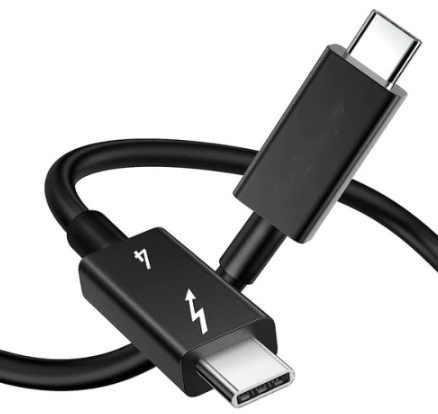
On a Thunderbolt or USB4 port, the picture expands. Thunderbolt 4 and USB4 tunnel DisplayPort, USB 3.x, and PCIe traffic through a single multiplexed protocol at up to 40 Gbps, dynamically reassigning bandwidth based on what's active. Thunderbolt 5 raises the ceiling to 80 Gbps, with an asymmetric 120 Gbps mode reserved for display traffic. Thunderbolt is Intel's protocol layered on top of USB-C as a connector — only products that pass Intel's Thunderbolt certification can carry the Thunderbolt name and logo.

The Power Path — Why Docks Plug Into the Wall
A dock's power brick does two jobs at once: it feeds the dock's internal chips plus all the connected peripherals, and it pushes spare wattage back through the USB-C cable to charge the laptop. This reverse delivery uses the same USB Power Delivery (PD) protocol that handles charging — the dock just acts as the source instead of the sink.
This is where most spec sheets become misleading. A dock marketed as "100W" usually ships with a 135W or 150W power brick. After the dock's internal controllers, display engines, USB hubs, and fans take their share — typically 13 to 15W — the rest is available downstream. What reaches the laptop is the PD output to host, often 85 to 90W on a "100W dock." If your laptop needs 100W to charge at full speed under load, an 85W feed will keep it running but slowly drain the battery.
The fix isn't to chase the highest-wattage dock on the shelf. It's to check two numbers: your laptop's PD input requirement (in its official spec sheet) and the dock's downstream PD output to host (listed separately from the power brick's total wattage on a reputable dock's spec sheet).
Two Ways Docks Drive Displays — DP Alt Mode vs DisplayLink
Docks drive external monitors using one of two fundamentally different methods, and the choice affects what works on your laptop and what doesn't.
DP Alt Mode docks route native DisplayPort signal straight from your laptop's GPU through the USB-C cable. The dock itself doesn't process the image — it acts as a switch, splitting the DisplayPort stream across HDMI or DisplayPort outputs. The upside is real: no drivers, near-zero latency, full support for high refresh rates and HDR. The catch is that the dock can only do what your laptop's USB-C port permits. To extend across two displays from a single DP stream, both the host and the dock need to support Multi-Stream Transport (MST).
DisplayLink docks take a different approach. They include a dedicated chip (made by Synaptics) that captures the screen as a video stream, compresses it, and sends it as USB data through the same cable. A driver on the laptop side decodes the stream and dispatches it to the dock's monitors. This bypasses the host's native display capability entirely — which is why DisplayLink docks can extend to multiple monitors even when the laptop's USB-C port officially supports only one. The tradeoffs: you have to install and update a driver, there's a small amount of encoding latency (noticeable in fast-paced games, invisible in office work), and HDCP-protected video streams may refuse to play.
Why this matters: macOS handles DP Alt Mode differently from Windows. Under DP Alt Mode, macOS does not support MST — connect a single-input USB-C dock to a Mac and the second monitor will mirror the first, not extend. The same dock on Windows extends correctly. The accepted workaround is a DisplayLink dock, which presents each monitor as a virtual display through the driver and sidesteps the macOS MST limitation.

Docking Station vs USB Hub vs Multiport Adapter — What's Actually Different?
The fastest way to tell these three apart: a docking station plugs into the wall, a USB hub doesn't, and a multiport adapter sits somewhere in between.
|
Feature |
USB Hub |
Multiport Adapter |
Docking Station |
|
External power |
No (bus-powered) |
Usually no |
Yes (wall adapter) |
|
Video outputs |
Rare — one HDMI at best |
Usually 1–2 |
Multiple (HDMI + DisplayPort, often 2–3 displays) |
|
Ethernet |
No |
Sometimes |
Yes (Gigabit or 2.5G common) |
|
PD to host |
None or pass-through only |
Pass-through up to 100W |
Active reverse PD output (typically 60–100W) |
|
Form factor |
Small, portable |
Small, portable |
Desk-side, stationary |
|
Typical price |
$15–$50 |
$30–$80 |
$100–$400 (USB-C); $200–$500 (Thunderbolt) |
|
Best for |
A few extra USB-A ports on a slim laptop |
Travel, occasional second screen |
Daily multi-monitor desk setup |
Pick a USB hub if all you need is more USB-A ports for a keyboard, mouse, and a flash drive. Pick a multiport adapter if you travel often and occasionally mirror to a projector or hotel TV — they fit in a backpack pocket. Pick a docking station if you have a fixed desk where you connect two or more monitors, wired Ethernet, and several peripherals, and you want to dock and undock the laptop with a single cable.
Will a Docking Station Work With Your Laptop?
Before you buy any dock, check five things about your laptop. Most dock returns come from skipping these checks — not from buying the wrong dock.
1. Does the laptop have a USB-C or Thunderbolt port at all? Some budget laptops still ship with only USB-A and HDMI. If yours does, your options narrow to older USB-A docks with lower bandwidth ceilings.
2. Does that USB-C port support DP Alt Mode? This is the deal-breaker most buyers miss. Not every USB-C port outputs video — some are wired for data and charging only. To check: search "[your laptop model] specifications" on the manufacturer's website and look for "DisplayPort over USB-C" or "USB-C with DisplayPort Alternate Mode." Some laptops — notably ThinkPad and HP business series — mark the video-capable port with a small "D" or DisplayPort icon next to the connector; others (including most MacBooks and consumer ultrabooks) don't, in which case the OEM specification sheet is the authoritative source. On Thunderbolt-equipped laptops, the port carries a lightning bolt icon, and every Thunderbolt port supports DP Alt Mode by default.
▪ USB 3.2 Gen 1: 5 Gbps — workable for one 4K@30Hz display plus a few peripherals
▪ USB 3.2 Gen 2: 10 Gbps — comfortable for one 4K@60Hz display
▪ USB 3.2 Gen 2x2: 20 Gbps
▪ USB4 / Thunderbolt 4: 40 Gbps — required for reliable dual 4K@60Hz over a single cable
▪ Thunderbolt 5: 80 Gbps (asymmetric 120 Gbps for displays)
4. Does the dock's PD output match your laptop's needs? Find your laptop's required PD input (often listed as "Type-C 65W" or "Type-C 100W") and compare it to the dock's downstream PD output to host. If the dock outputs less than your laptop needs at full load, you'll see a "slow charger" notification and the battery will trickle down during heavy use.
5. Operating-system limits. Under DP Alt Mode, macOS does not support MST — a single-input USB-C dock will mirror, not extend, on a Mac. Windows handles MST natively. macOS users needing multi-monitor extension should look for a DisplayLink-based dock instead. Apple Silicon Macs also have per-chip limits on native external display count — the base M1 and M2 officially support one external display in extended mode; M1 Pro, M2 Pro, and newer expand this. Verify against Apple's official spec for your specific model.

Do You Actually Need a Docking Station?
A docking station pays off when the friction it removes is friction you actually feel. Most laptop users don't need one — and the ones who do already recognize the symptoms.
You probably don't need one if: you connect at most one monitor and a peripheral or two at a time, you use the laptop mostly as a laptop (rarely at a fixed desk for hours), or a simple USB-C hub already covers your setup.
You'll benefit from one if: you run two or more external displays daily, you dock and undock the laptop at least once a day, you depend on wired Ethernet for stable video calls and large transfers, or you connect more than three peripherals (keyboard, mouse, webcam, external drive, audio interface).
You almost certainly need one if: you manage a hot-desking office or a small fleet of laptops where consistent peripheral setups across desks matter, or you run high-bandwidth work (4K video editing, multi-screen development, dual-stream conferencing) where bandwidth bottlenecks cost time every day.
Common Misconceptions
Five myths drive most bad dock purchases. Knowing them in advance saves you a return.
"Any USB-C port can drive a USB-C dock." False. The USB-C connector is just a shape — the underlying protocol determines what works. A USB-C port wired for charging and data only won't output video to a dock, regardless of what the dock advertises.
"USB4 and Thunderbolt 4 are the same thing." Not quite. USB4 is the USB-IF protocol specification; Thunderbolt 4 is Intel's certified implementation built on top of it. All Thunderbolt 4 ports satisfy USB4 requirements, but not every USB4 port is Thunderbolt 4 — Intel's certification layer adds stricter requirements (guaranteed 40 Gbps, dual 4K display support, 32 Gbps PCIe minimum). A Thunderbolt-certified port is a safer bet for high-end docks; a generic USB4 port may meet most of the same specs but isn't guaranteed to.
"A 100W PD dock charges my laptop at 100W." Almost never. "100W" refers to the dock's total power brick output. After the dock's internal chips take their share — typically 13 to 15W — the downstream PD output to host is usually 85 to 90W. Look for "PD output to host" or "upstream charging" on the dock's spec sheet — that's the number that determines whether your laptop charges at full speed.
"My Mac can extend to three monitors through a USB-C dock." Not under DP Alt Mode. macOS does not implement MST over DP Alt Mode, so a single-input USB-C dock will mirror the same image across additional displays. Workarounds exist — a DisplayLink dock presents each external monitor as a virtual display, and Apple Silicon Macs with M1 Pro or newer can drive multiple displays through Thunderbolt — but a generic USB-C dock on a base MacBook Air won't extend.
"A USB hub and a docking station are basically the same thing." They aren't. A hub draws power from your laptop and expands USB ports only. A dock has its own power supply, adds video, network, audio, and reverse charging, and doesn't brown out under load.
Next Steps — If You're Considering a Docking Station
If a dock looks like the right tool, work through these five steps before opening a buying guide.
1. Confirm your laptop's USB-C capability from the OEM spec sheet: DP Alt Mode support, PD input range, and USB protocol generation (USB 3.2 Gen 2 / USB4 / Thunderbolt 4 / Thunderbolt 5). Write down all three.
2. List your required ports. How many monitors and at what resolution and refresh rate? How many USB-A peripherals? Ethernet — yes or no? SD card reader — yes or no?
3. Calculate your real PD wattage need. Find your laptop's required PD input. The dock's downstream PD output to host needs to meet or exceed that figure — not just the dock's total power brick rating.
4. Choose between DP Alt Mode and DisplayLink based on your OS and monitor count. macOS users needing multi-monitor extension on a base-chip Mac: lean toward DisplayLink. Windows users with an MST-capable host: DP Alt Mode works fine.
5. Then compare specific products. Only at this point do individual product pages help — search for the type of dock that matches your shortlist (e.g., "USB4 dock dual HDMI 100W PD") rather than starting from brand recommendations.
For the full decision framework — matching the dock to your host port's protocol, sizing the PD output, and verifying the dock delivers its rated specs on arrival — see our detailed guide on how to choose a USB-C docking station.
A docking station is a powered port expander built around one architectural choice: wall power flowing outward instead of laptop power flowing inward. Whether it's worth buying depends less on the dock and more on what your laptop's USB-C port can actually do. Check that first, and the right dock follows.