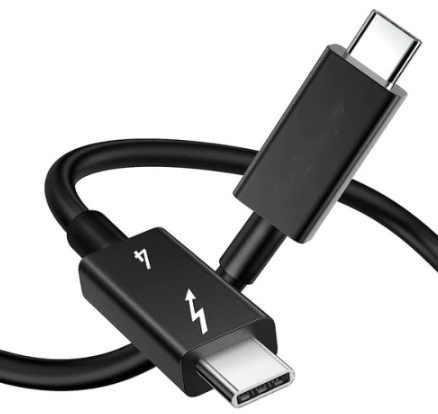
You may often see the comparison discussion of "Thunderbolt 4 vs Thunderbolt 5" when browsing spec sheets or following new product launches. For users who rely on high-speed file transfers, multiple 4K monitors or single-line laptop docks, this is not a marketing gimmick, but a key factor in whether daily use is smooth.
Thunderbolt 4: Stable and efficient multi-functional connection standard
Introduced by Intel in 2020, Thunderbolt 4 has become the standard for many high-end laptops and docking stations. It uses the familiar USB-C interface, but with excellent performance.
Bandwidth and Display: Each certified port provides 40 Gbps bandwidth, supports dual 4K-60Hz displays or a single 8K display, and has a PCIe throughput of at least 32 Gbps, which is ideal for external SSDs, high-resolution displays or external GPUs.
Connection and Expansion: Supports cables up to 2 meters long without compromising speed, and can daisy-chain up to six devices with stable performance.
Security: Enhanced security through DMA protection (Intel VT-d), effectively preventing malicious devices from accessing system memory.
Power supply and functions: Support up to 100W laptop charging power, provide at least 15W power for accessories, support sleep wake-up and other functions under the dock setting, and improve office convenience.
Thunderbolt 5: The next-generation standard with a leap in performance
Intel officially released Thunderbolt 5 in 2023, which brought significant improvements on the basis of Thunderbolt 4.
Bandwidth and "Bandwidth Boost": Bidirectional bandwidth is up to 80 Gbps, and with the "Bandwidth Boost" function, it can be dynamically increased to 120 Gbps to meet the needs of high-resolution displays.
Display performance: Through DisplayPort 2.1 alternative mode, a single port can drive three 144Hz 4K panels, two 6K screens or a pair of 8K displays to meet the needs of creators, gamers and heavy users.
Charging Performance: Support for USB PD 3.1 extended power range provides up to 240W of power, allowing a single cable to charge a powerful workstation or gaming laptop.
Cable Length and Flexibility: Passive cables can be extended up to 3 meters without compromising speed, bringing greater flexibility to desktop settings or production environments.
Thunderbolt 4 vs. Thunderbolt 5: Core Differences
Bandwidth and Speed: Thunderbolt 5 doubles bandwidth to 80 Gbps and can dynamically increase to 120 Gbps, enabling faster NVMe RAID performance and smoother 8K workflows.
Display Capabilities: Thunderbolt 5 supports more high-resolution display combinations, including 540Hz 4K displays in gaming rigs.
PCIe and Data Throughput: Thunderbolt 5 increases PCIe 4.0 to 64 Gbps, doubling the channel bandwidth for external GPUs, AI accelerators, and multi-disk enclosures.
Power Delivery: Extended charging power up to 240W, single-cable charging is enough for a 17-inch workstation or gaming laptop.
Cable Length & Compatibility: Passive Thunderbolt 5 copper cables can extend up to 3 meters, maintain 80 Gbps speeds, and work perfectly with Thunderbolt 3, Thunderbolt 4, USB4, or regular USB-C devices.
Security & Certification: Both generations use Intel VT-d DMA protection and are fully Intel/USB-IF certified to ensure performance is consistent with the hype.
Conclusion
Whether you choose Thunderbolt 4 or Thunderbolt 5 depends on your specific needs. If your current workflow rarely reaches the peak speed of 40 Gbps, or if you value broad compatibility, Thunderbolt 4 is a solid choice. If you need to transfer large media files, use a high-refresh 4K display at the same time, or want to future-proof the port, Thunderbolt 5 is a smarter choice. Whichever you choose, you can ensure that your device can keep up with you and meet your future needs.