
The short answer: After this lineup-wide price increase, a PS5 is worth buying for a narrower group of people—but if you know exactly what you want from it, this may be the least compelling time in years to keep waiting.
In 2026, Sony introduced another round of price increases across the global PS5 lineup, including both Slim models and the Pro, with changes in mainland China and the United States taking effect at the same time. If you mainly want to play Sony's first-party exclusives, the PS5 currently has no substitute, and the upward price trend suggests waiting will probably cost you more. If you simply want a place to play multiplatform AAA games, the PS5 is no longer the best value after the increase. Below, we break down the current models, the cost of ownership, independent Slim-versus-Pro tests, and the best choice for three types of players.
1. Which PS5 models are on sale in 2026?
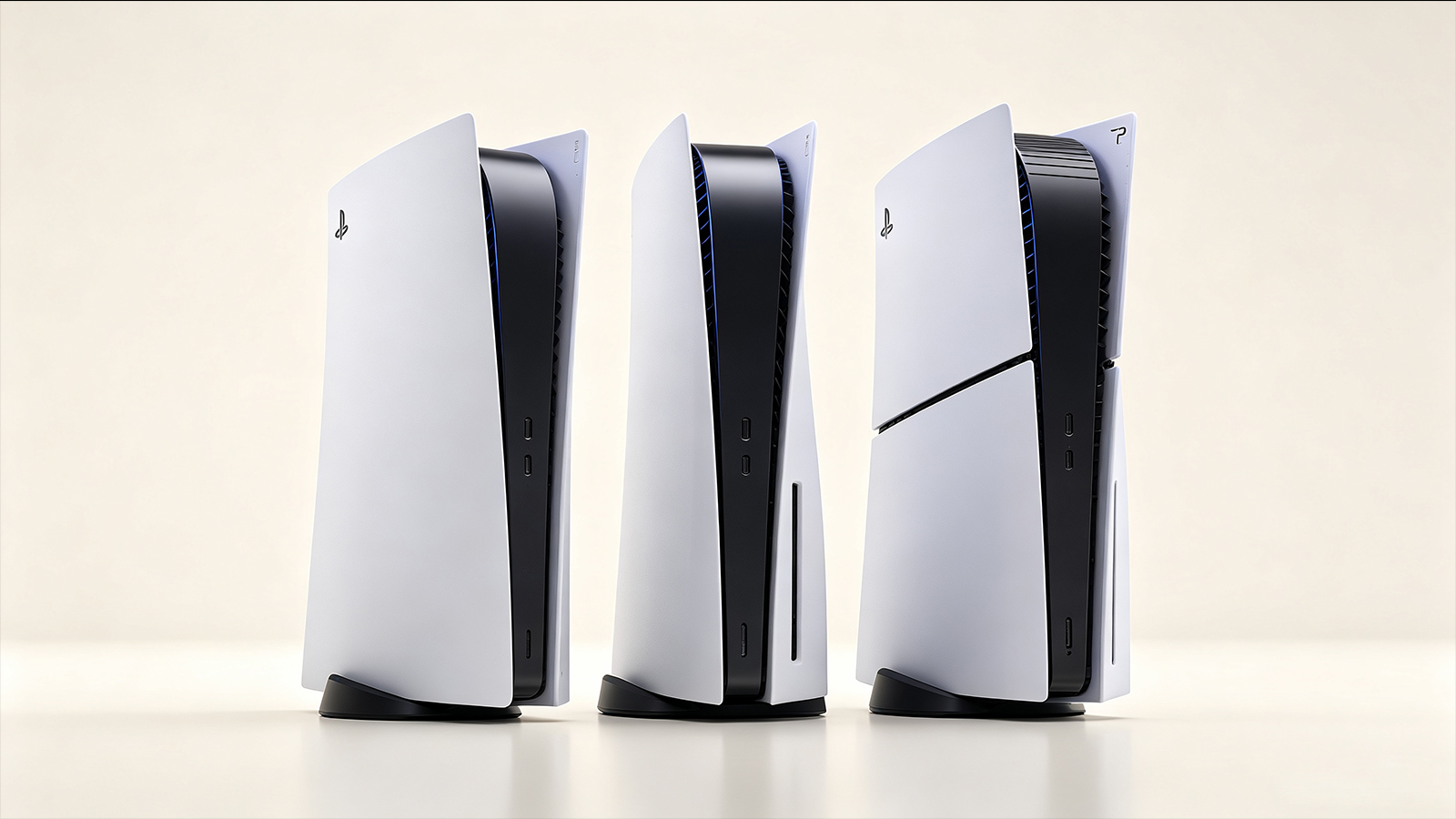
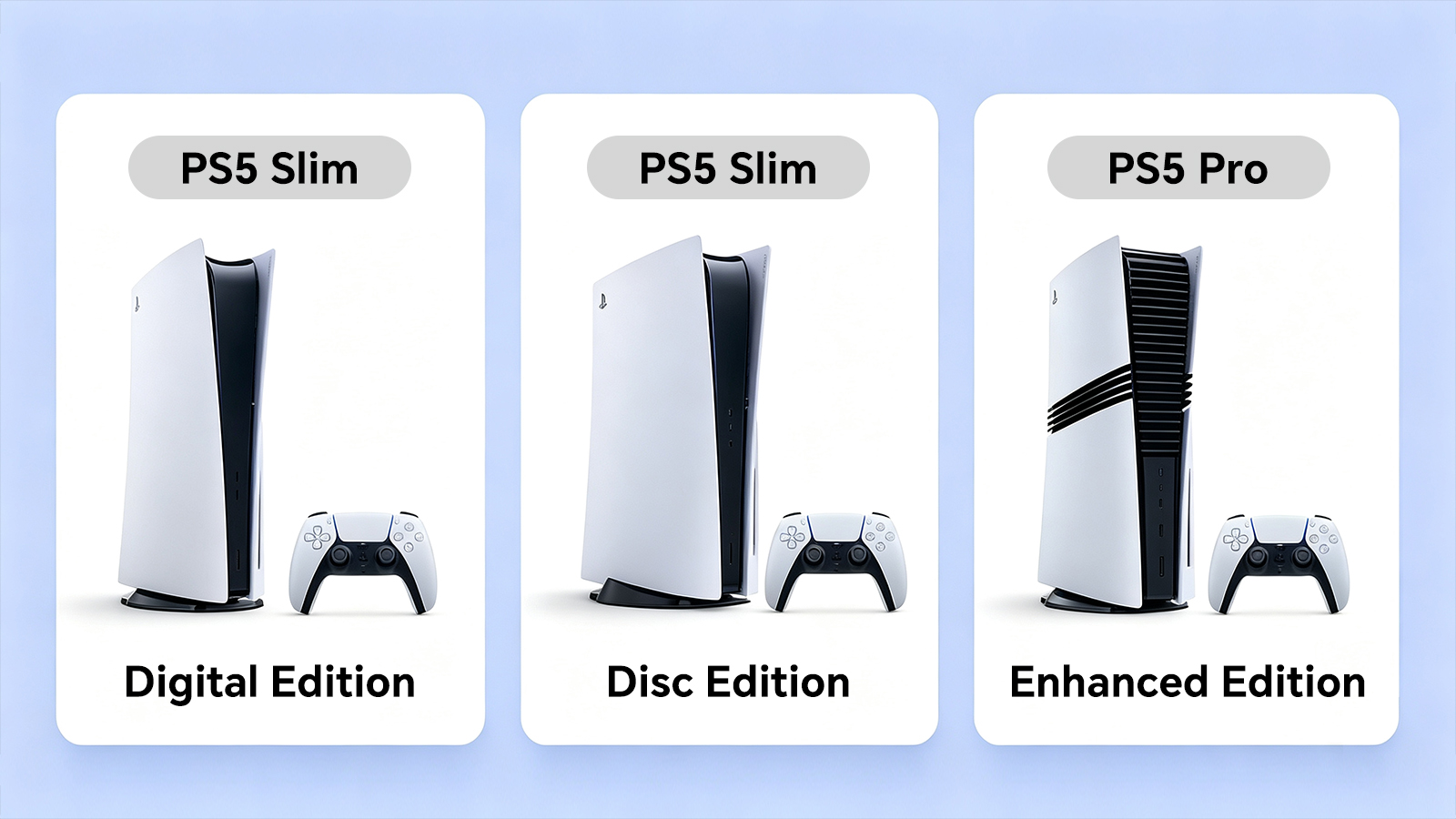
Before choosing a console, clear up a common source of confusion: the three PS5 models people talk about do not all belong to the same hardware revision. The original PS5, launched in November 2020 and often called the "fat" model, has been discontinued. New retail stock now generally consists of two consoles—the smaller CFI-2000 series introduced in November 2023 (commonly called the PS5 Slim, although Sony does not use that name officially) and the PS5 Pro introduced in November 2024. Because the Slim comes with or without a disc drive, you are effectively choosing among three SKUs.
1.1 What actually differs among the three models
One key point comes first: the Slim and the original PS5 offer the same gaming performance. The smaller revision changed the size, weight, power use, and cooling layout; it was a design refinement, not a performance upgrade. The PS5 Pro is the only model in the lineup with a meaningful performance increase.
| Model | PS5 Slim Digital Edition | PS5 Slim Disc Edition | PS5 Pro |
|---|---|---|---|
| GPU compute power | 10.28 TFLOPS | 10.28 TFLOPS | 16.7 TFLOPS |
| CPU | 8-core Zen 2 | 8-core Zen 2 | 8-core Zen 2 (high-frequency mode) |
| Memory | 16GB GDDR6 | 16GB GDDR6 | 16GB GDDR6 + 2GB DDR5 |
| Internal storage | 1TB (825GB in some later batches) | 1TB | 2TB |
| Disc drive | None; optional add-on | Included, detachable | None; optional add-on |
| Upscaling | AMD FSR | AMD FSR | PSSR (AI upscaling) |
| Wireless | Wi-Fi 6 | Wi-Fi 6 | Wi-Fi 7 |
| Ray tracing | Basic | Basic | Enhanced (about 2×, according to Sony) |
| Best for | Digital-only buyers who mainly use the PlayStation Store | Mainstream players who want physical games | Owners of 4K high-refresh-rate TVs who prioritize image quality |
One detail to watch for: Sony revised the Slim Digital Edition at one point, reducing its internal storage from 1TB to 825GB without much publicity. If you buy the Digital Edition, check the capacity printed on the box when it arrives, then compare it with the product listing. That can save you a later conversation with customer service.
2. After the lineup-wide price increase: Choose the model and purchase format before buying a PS5
The PS5 is one of the rare consoles that has become more expensive the longer it has been on sale. Since its November 2020 launch, Sony has raised official prices more than once. The increases that took effect in April 2026 covered the widest range of markets yet: mainland China and the United States moved at the same time, alongside the United Kingdom, Europe, and Japan. Sony attributed this round to the global economic environment and higher component costs, specifically citing rising prices for memory and NAND flash.
The increases were uneven: the Slim Digital Edition and PS5 Pro saw relatively large adjustments, while the Slim Disc Edition had the smallest increase in the lineup. This was also the first price increase for the PS5 Pro since launch. The result is somewhat counterintuitive—the old assumption that the Digital Edition costs substantially less than the Disc Edition no longer holds as strongly. The gap has narrowed, and the extra money for the Disc Edition buys access to physical games, resale value, and 4K UHD Blu-ray playback. Its relative value has therefore improved.
2.1 Look beyond the console: A three-year cost breakdown
A common pattern is to treat the console purchase as the whole expense, only to keep spending on accessories and subscriptions over the next two or three years. For a Disc Edition owner with typical usage, the rough three-year spending breakdown looks like this:
| Category | When you pay | Share of three-year spending |
|---|---|---|
| Console | One-time purchase | About 30% |
| Extra controller (local multiplayer) | One-time purchase | Small share |
| SSD upgrade | Optional, one-time purchase | Small share |
| PS Plus membership | Annual renewal | Moderate share |
| Games | Accumulated annually; increases over time | Largest share |
The price increase has not changed the basic pattern: the console itself still accounts for only about 30% of total spending over three years. Games and subscriptions make up the larger share, and those costs recur and grow over time.The real question is whether playing the specific games you want on PS5 is good value, rather than whether the console alone seems expensive. If you plan to resell physical games, the Disc Edition can often justify its extra cost through resale within a year. If you are certain you will buy everything digitally, you can save the upfront difference, but adding a disc drive later will cost more, and you will give up the resale value of physical copies.
Storage deserves special attention. Rising prices for memory and NAND flash in recent years have pushed up SSD costs, and Sony also cited component costs when explaining this round of console increases. For buyers, that suggests two practical steps: plan for any storage upgrade when you buy the console, and assess the SSD's specifications and heatsink design rather than looking only at capacity.
3. How Big Is the Real-World Gap Between the Slim and Pro? Independent Test Results
A spec sheet tells you what the hardware can do, but not what playing on it feels like. If you choose the Pro over the Slim, are you getting a visible improvement or just bigger numbers on paper? The following public test results and official information from Digital Foundry, Tom's Hardware, Computer Bild, and Square Enix break the answer down by game visuals, frame rate and power draw, and noise.
First, an important premise: the PS5 Slim has essentially the same core gaming performance as the original PS5—an eight-core Zen 2 CPU, 36 CU RDNA 2 GPU, and 16GB of GDDR6 memory. The Slim redesign changes the console's size, internal layout, and storage capacity. Tests comparing the original PS5 with the PS5 Pro therefore also indicate the gap between the Slim and Pro.
3.1 Visual Differences in the Same Game: FINAL FANTASY VII REBIRTH
This is one of the clearest comparisons available. In Performance Mode, the standard PS5 and Slim target 60 FPS, with a dynamic resolution reaching about 1440p and a common internal rendering resolution of about 1152p. The frame rate generally holds up, but the image looks noticeably soft. Hair, vegetation, distant buildings, and fine textures can appear blurry.
PS5 Slim / standard PS5 — Performance Mode
Target frame rate: 60 FPS
Maximum dynamic resolution: About 1440p
Common internal rendering resolution: About 1152p
Upscaling method: AMD FSR
PS5 Pro — Enhanced / Versatility Mode
Target frame rate: 60 FPS
Internal rendering: About 1080p–1440p, dynamic
Typical internal resolution: About 1224p
Output: PSSR upscaling to dynamic 4K
The key point is that the Pro does not improve image quality simply by increasing native resolution. It uses PSSR (PlayStation Spectral Super Resolution) to reconstruct the internally rendered image with machine learning. With the same 60 FPS target, the Pro produces a substantially clearer image than the standard PS5's Performance Mode. Square Enix's official explanation of the Pro's Enhanced Mode supports this approach: PSSR maintains the smooth 60 FPS performance target while bringing resolution close to Quality Mode. Digital Foundry further reports that the Pro's 60 FPS presentation is greatly improved over the standard PS5, addressing frame-rate drops in some Performance Mode scenes. Parts of the image even surpass the standard PS5's 30 FPS Quality Mode.
For buyers, the implication is straightforward: the Pro's value is not that it can run more games; it is that players have less need to choose between image quality and frame rate. At 60 FPS, it can approach the image quality of the standard PS5's Quality Mode. This benefit applies only to games with Pro enhancements.
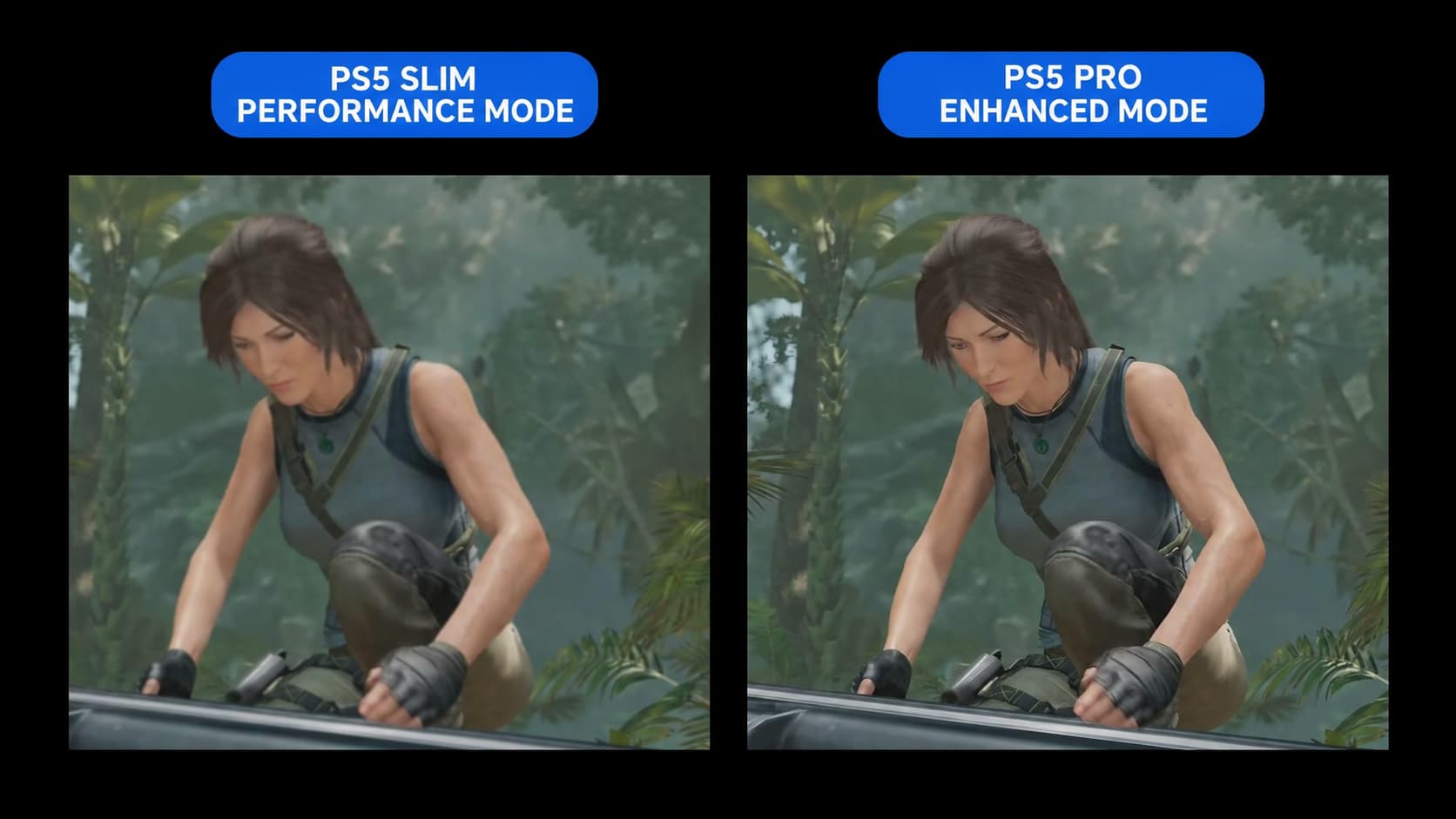
Illustrative image-quality comparison. The scene shown is not an in-game test screenshot from FINAL FANTASY VII REBIRTH and does not represent the independent test results cited in this article.
3.2 Frame Rate and Power Draw: ELDEN RING and Marvel's Spider-Man 2
One counterintuitive result in this data is that the more powerful Pro can draw less power than the Slim.
| Test scene | Console | Frame rate | Power draw |
|---|---|---|---|
| ELDEN RING Same test scene |
PS5 Pro | About 52 FPS | 214.1W |
| PS5 Slim | About 40 FPS | 216.2W | |
| Launch-model PS5 | About 37 FPS | 201.3W | |
| Marvel's Spider-Man 2 All three at about 60 FPS |
PS5 Pro | About 60 FPS | 232W |
| PS5 Slim | About 60 FPS | 218.2W | |
| Launch-model PS5 | About 60 FPS | 208.1W |
How to read these figures: The 40 FPS versus 52 FPS figures for ELDEN RING are a snapshot of one scene in Digital Foundry's testing, not average frame rates for the entire game. They do not mean that the Pro is 30% faster than the Slim throughout the game. In Spider-Man 2, the Pro draws more power because it is also running Pro-enhanced graphics settings. Together, these examples show that the Pro does not consistently draw a fixed number of watts more than the Slim. Actual power consumption varies with the game, GPU load, frame rate, and enhanced graphics mode.
3.3 Noise: The Pro Is Quieter Under Full Load
Under the same test conditions, Computer Bild measured approximately 0.71 Sone for the PS5 Pro at full load and approximately 0.86 Sone for the PS5 Slim at full load. In a separate Computer Bild test focused on the Slim, it measured up to about 0.9 sone while gaming, compared with about 0.8 sone for the earlier standard PS5.
A qualification is essential: noise figures cannot be compared without considering test conditions. Fan suppliers, production batches, ambient noise, measurement distance, and game load can all affect the result. The significance of 0.71 versus 0.86 is that it is a comparison made by the same publication under the same test conditions, not proof that every Pro is quieter than every Slim.
What these results mean for buyers: Compared with the Slim, the Pro delivers a higher frame rate in the same scene and is slightly quieter under full load, while power draw depends on the game. In other words, what you gain with the Pro is frame-rate performance and image reconstruction, not an inherently noisier and more power-hungry console. If heat or noise has made you hesitate, these test results may ease some of that concern.
4. Game Library: The PS5's Strongest Advantage Today
On hardware specifications alone, the PS5 is not especially competitive in 2026—even less so after the price increase, when a PC at a similar price can match its raw computing power. The real reason to buy is the game library: Sony's major first-party narrative games generally debut on PlayStation. By 2025, the PS5 had built up a catalog including God of War Ragnarök, Marvel's Spider-Man 2, Horizon Forbidden West, The Last of Us Part I, Gran Turismo 7, Astro Bot, and 2025 releases DEATH STRANDING 2: ON THE BEACH and Ghost of Yōtei. Many of these titles have received extensive critical acclaim and awards.
As for upcoming games, first-party titles such as Marvel's Wolverine remain in development; check official announcements for release windows. Claims that a major game is available only on PS5 are often overstated online. Before buying, check PlayStation's website or the publisher's official page to confirm platform availability rather than relying on secondhand claims.
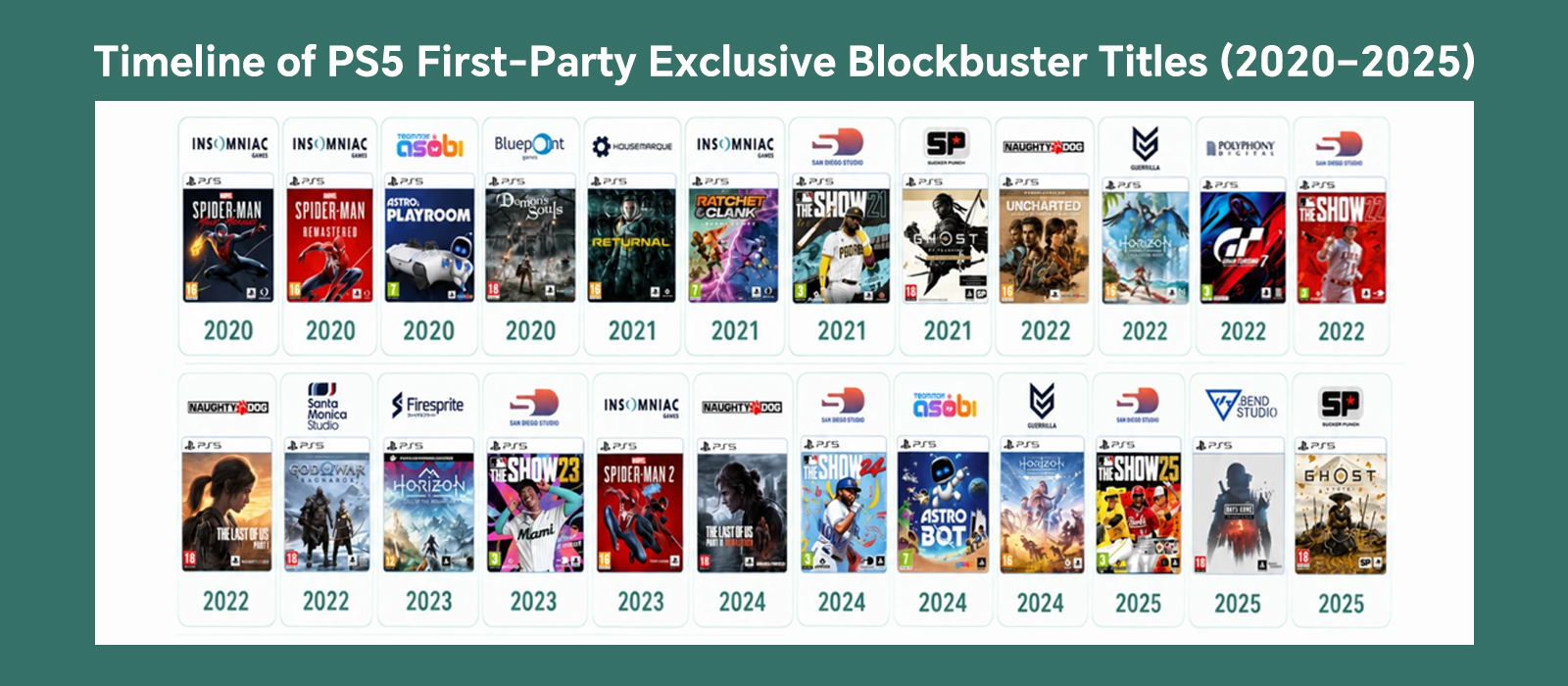
Illustrative timeline of game covers. The "Exclusive" heading in the image does not mean every title remains exclusive to the platform. Consult official pages for current platform availability.
4.1 Should You Choose a Disc or Digital Console?
The Slim and Pro both use detachable disc drives, so buying a Digital Edition and adding a drive later is technically possible. In practice, though, buying the drive separately is an additional expense, and the combined cost can exceed that of buying the disc-drive model outright. A disc drive also offers more than the ability to insert a game: you can buy and resell used physical games, use the console as a 4K UHD Blu-ray player, and keep a physical copy without depending on a digital storefront continuing to list it.
The latest price increase makes the choice clearer. The disc-drive model saw the smallest increase in the lineup, narrowing its price gap with the Digital Edition, while the cost of adding a drive later has not fallen. Its relative value has therefore improved. The rule of thumb is simple—if you buy fewer than five games a year and buy them at launch, choose the Digital Edition. If you wait for sales, buy used games, or resell games when finished, choose the disc-drive model.
5. Which PS5 Should You Buy? Recommendations for Three Types of Players
There is no universal answer to whether a PS5 is worth buying. It depends on the kind of player you are. Here are recommendations for three common situations.
Committed PS5 Player — Buy Now
Profile: You have specific PS5-only games you cannot miss, or your friends and multiplayer group play on PlayStation.
Recommendation: Buy the PS5 Slim with a disc drive. It is the most balanced choice in the lineup: you get the core performance and access to physical games at a substantially lower price than the Pro.
Why: The old advice to wait for a price cut has not worked well for this console generation. PS5 prices have trended upward, so waiting may bring a higher list price rather than a discount. For this group, the cost of waiting and the risk of missing out outweigh the price difference.
Mostly Multiplatform Player — Consider Used Hardware or Reassess
Profile: You have no must-play exclusive games, mostly play multiplatform titles, and use a console only occasionally.
Recommendation: Consider a well-kept used PS5 Slim with a disc drive first, or look into a PC or subscription option. If you still plan to wait for a major sale, bear in mind that discounts may no longer offset the official price increase.
Why: After the price increase, the console's upfront cost matters more. If PS5 exclusives were never a compelling reason for you to buy, the value proposition is especially weak now.
Visual-Quality Enthusiast / Early Adopter — Check Your Display Before Choosing Pro
Profile: You already own a high-refresh-rate 4K TV or a high-end monitor and care about stable frame rates and image quality.
Recommendation: Check your display first, then decide whether to buy the Pro. On a capable screen, its PSSR upscaling and enhanced ray tracing can make a real visible difference. On an older 1080p or 60Hz TV, much of the Pro's advantage will be difficult to appreciate.
Additional context: The Pro had the largest increase in this round. Sony still positions it as an upgrade for existing PS5 owners rather than an entry-level console for newcomers. If you already own a PS5, the main reason to upgrade is getting visuals closer to Quality Mode without giving up frame rate—whether that matters enough is a personal decision.
6. After the Price Increase, How Does PS5 Compare With PC, Xbox, and Switch 2?
First, these platforms are not entirely mutually exclusive. Many players end up with a console and a lightweight laptop rather than choosing only one device. The real question is where you spend most of your gaming time. The price increase makes that decision more consequential—as the cost of a console rises, the price gap between it and a gaming PC no longer settles the question as readily as it once did.
| Platform | Strengths | Drawbacks | Best for |
|---|---|---|---|
| PS5 | First-party exclusives, plug-and-play setup, resale value of physical games, and accessible 4K gaming | Repeated console and membership price increases, fixed performance ceiling, and lower multiplatform visual quality than a high-end PC | Players drawn by exclusives who prefer a simple setup |
| Gaming PC | Higher visual ceiling, mod support, multiple uses, flexible upgrades, and frequent storefront promotions | Higher total cost at comparable image quality, driver and compatibility issues, and a less convenient living-room experience | Players who enjoy tinkering and also need a computer for other work |
| Xbox Series X / S | Day-one access to games in its subscription library, strong backward compatibility, and flexible cross-platform purchasing | Relatively weaker first-party exclusive lineup, with hardware prices also affected by component costs | Frequent players who want a subscription to cover most of their games |
| Switch 2 | Portable and TV play, distinctive first-party games, and family-friendly multiplayer | Compromises in major third-party AAA games, a different performance tier, and a relatively closed ecosystem | Families and commuters who also want Nintendo games |
In short, you buy a PS5 for convenient access to Sony's games, not for raw performance. If that does not appeal to you, a PC or subscription service is likely a better fit in today's hardware and platform landscape.
7. Six Common Mistakes After the Price Increase
- 1 Counting the console price but overlooking accessories and subscriptions. Over three years, accessories, subscriptions, and games account for much of the total cost. Add everything up before you order.
- 2 Judging prices by what you remember from before the increase. Many buying guides online still cite prices from before the increase. Those figures may no longer reflect current prices through official channels, so check the latest information from official sellers before buying.
- 3 Buying a Digital Edition before realizing you want physical games. Adding a detachable disc drive later can cost more overall than buying the disc-drive model outright, especially now that the price gap between the two has narrowed.
- 4 Overlooking storage capacity and rising storage costs. A 1TB model has about 830GB of usable space, while a single AAA game now often exceeds 100GB. Rising memory and flash prices have already increased SSD procurement costs. If you expect to expand storage, plan for it when you budget for the console.
- 5 Buying a used launch-model console just because it is cheaper. The launch model has been discontinued, and most used units have already seen years of service. They have less storage than the Slim model, and most are out of official warranty. Used prices have risen alongside new-console prices, so the savings may not offset those risks.
- 6 Assuming a game is truly exclusive without checking. Many games advertised as PS exclusives later arrived on PC. If exclusivity is a reason to buy, check the platform listing on the official game page first.
8. Storage Expansion Tested: How Fast Is a 7,450MB/s SSD in a PS5?
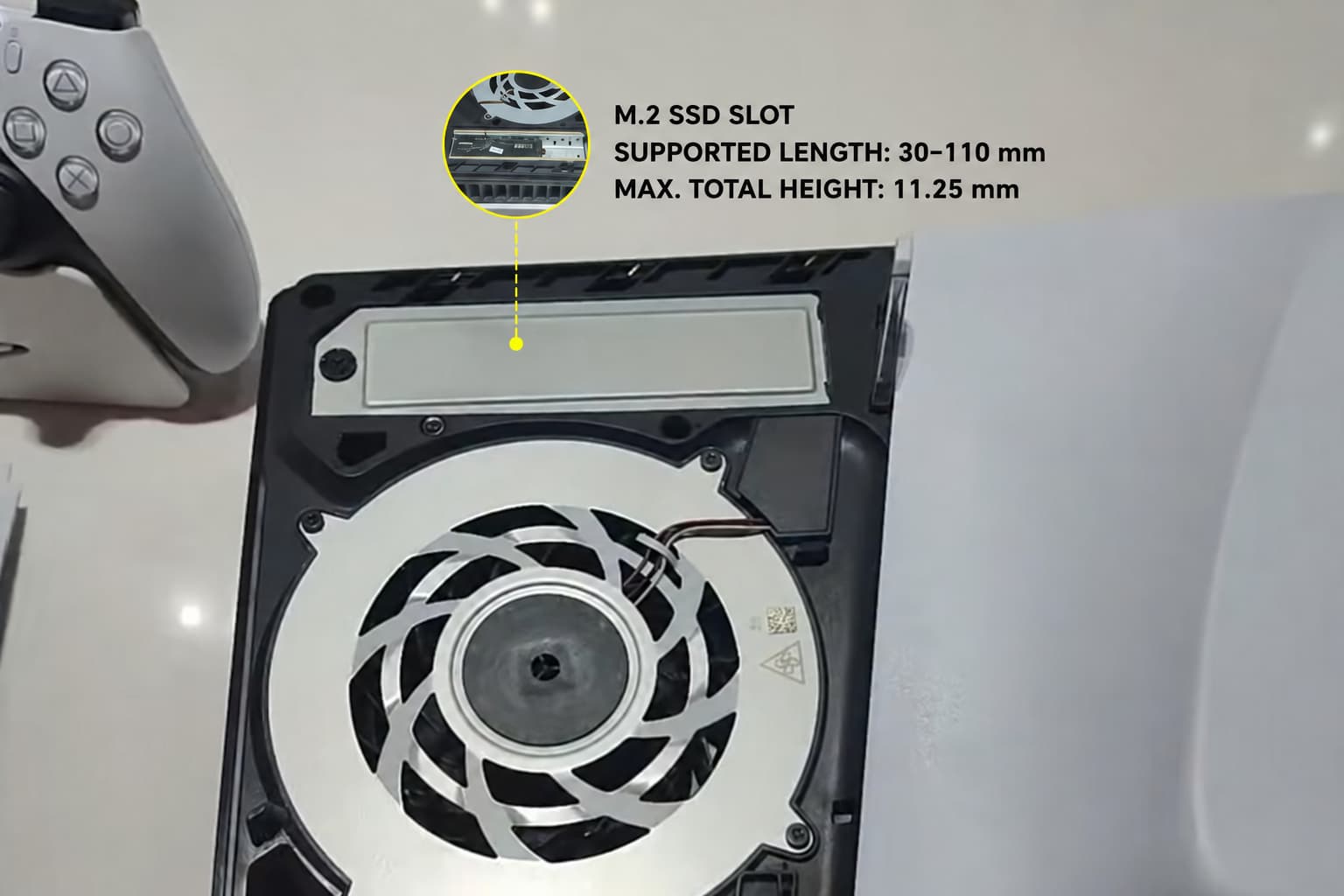
Storage is one of the easiest PS5 costs to underestimate. A 1TB model has about 830GB of usable space, and a single AAA game now often exceeds 100GB. Install four or five and you may already need to delete games. Adding an M.2 NVMe drive is the standard solution, but advertising claims of “over 7,000MB/s” can be misleading—this set of measured results is worth reviewing before you spend.
8.1 Measured PS5 Results for Four Flagship SSDs
Tom's Hardware tested four high-end M.2 SSDs in a PS5 (the Micron 4600 uses PCIe 5.0; the other three use PCIe 4.0). Their results were remarkably similar:
| SSD Model (2TB) | Manufacturer-Rated Sequential Read | PS5 Measured Read | Internal SSD → M.2 | M.2 → Internal SSD |
|---|---|---|---|---|
| Samsung 990 Pro | 7,450MB/s | 6558MB/s | 2495MB/s | 252.2MB/s |
| Micron 4600 | 14,500MB/s | 6566MB/s | 2484MB/s | 251.4MB/s |
| WD Black SN850X | 7,300MB/s | 6531MB/s | 2495MB/s | 250.2MB/s |
| SK hynix Platinum P41 | 7,000MB/s | 6507MB/s | 2492MB/s | 251.4MB/s |
Note: The manufacturer-rated column lists each 2TB model's maximum sequential read speed under the manufacturer's test conditions. Those figures and the PS5 results come from different test environments. Sources for rated speeds: Samsung, Micron, WD, SK hynix; source for PS5 measurements: Tom's Hardware.
Three patterns stand out. First, measured read speeds in the PS5 cluster closely together: despite substantial differences in rated speeds, all four drives delivered 6,500–6,570MB/s in the PS5, suggesting that the drive itself is not the bottleneck. Second, copy speeds differ sharply by direction: copying from the internal SSD to M.2 reached about 2,490MB/s, while the reverse direction managed only about 251MB/s—nearly a tenfold difference. Third, rated speeds do not directly predict the experience—the 990 Pro is rated at 7,450MB/s but measured 6,558MB/s in the PS5, about 88% of its rating.
8.2 How Long Does It Take to Transfer a 100GB Game?
A test with an approximately 100GB copy of Cyberpunk 2077 and a Samsung 980 Pro makes the effect of transfer direction clear:
PS5 Internal SSD → M.2
1 min 11 sec
Average speed: about 1.42GB/s
M.2 → PS5 Internal SSD
7 min 18 sec
Average speed: about 230MB/s
The game and the two SSDs were the same; only the transfer direction changed, yet the transfer took more than six times as long. That helps explain why some players feel the upgrade is “not as fast as expected”—the value of a fast M.2 drive is more capacity while maintaining game-read performance, not making every file operation run at the drive's rated speed of several thousand MB/s. The read-heavy tasks players notice most in daily use (startup, loading, and fast travel) do benefit, but allow for the difference when copying files in either direction.
Storage Upgrade Buying Tip: Because the PS5 limits these drives to broadly similar read speeds, there is little reason to pay a substantial premium for a higher rated speed. Check three things instead: whether the capacity meets your needs, whether the drive has a heatsink (the PS5 specifies a maximum overall heatsink height), and the long-term reliability of its flash memory and controller. Once rated speeds exceed 6,500MB/s, the extra benefit is small.
9. The Next Generation: How Much Should You Believe the Rumors?
Important note: Everything in this section comes from unofficial hardware leaks and concerns two separate leads: a rumored handheld and a rumored lower-spec home console called “PS6 Lite.” As of September 2026, Sony has not officially announced the name, final hardware specifications, commercial details, or launch date of either product. Nor has it confirmed that either project exists. None of the figures in this section should guide a purchase or change any of the conclusions earlier in this article.
9.1 The Handheld Lead: Rumored Specifications for the Canis Chip
Recent leaks focus on a handheld codenamed Project Canis. The rumored specifications include a custom 3nm AMD SoC; a six-core Zen 6 CPU (4×Zen 6c + 2×Zen 6 LP); 24GB of LPDDR5X memory on a 192-bit bus; a 16-CU RDNA 5 GPU; and a 15–25W TDP. The GPU is said to run at about 1.2GHz in handheld mode, for roughly 4.91 TFLOPS of raw FP32 compute, and at about 1.65GHz when docked, for roughly 6.75 TFLOPS. The leaks also suggest possible PSSR 3.0 support, with some AAA games rendered internally at around 540p and reconstructed to 1080p, targeting about 30–60 FPS.
How Should You Read the Claim That “14 TFLOPS Is Close to PS5 Pro”?
This is one of the most widespread claims and one of the easiest to misread. One leak describes Project Canis as delivering roughly 10–11 TFLOPS of “equivalent performance” in handheld mode and about 14 TFLOPS of “equivalent performance” when docked, while the PS5 Pro figure is approximately 16.7 TFLOPS of raw GPU FP32 compute.
These three figures do not belong in the same performance comparison. The raw GPU figures in the Project Canis leak remain 4.91 TFLOPS in handheld mode and 6.75 TFLOPS when docked. The 10–11 and 14 TFLOPS figures are described in leak coverage as “equivalent performance” after accounting for the perceived benefits of PSSR 3.0, AI reconstruction, and frame generation. They do not mean the GPU itself has 14 TFLOPS of raw FP32 compute.
This wording is incorrect
“Project Canis has 14 TFLOPS and PS5 Pro has 16.7 TFLOPS, so Canis delivers about 84% of the Pro's GPU performance.”
A more accurate statement
“The latest Project Canis leaks put raw GPU compute at about 4.91 TFLOPS in handheld mode and 6.75 TFLOPS when docked. The figures of 10–11 TFLOPS and 14 TFLOPS are claims of ‘equivalent performance’ that factor in PSSR 3.0, AI reconstruction, and frame generation. They cannot be compared directly as percentages with the PS5 Pro's 16.7 TFLOPS of raw FP32 compute.”
The practical lesson is this: be wary of the phrase “equivalent performance”. It is often a promotional description that folds the benefits of software techniques such as upscaling, AI reconstruction, and frame generation into a single figure. It is not the chip's actual floating-point compute, and there is no consistent conversion between the two. Measured frame rates in games are a more reliable guide to a device's real-world performance than TFLOPS.
9.2 A Separate Lead: The Rumored Two-Tier “PS6 Lite” Strategy
First, a caveat about this claim: In April 2026, hardware leaker Kepler_L2 was asked whether Sony would release a lower-spec home console based on its handheld chip. He said no and called such a plan a “nightmare” for developers—making a game look good on a handheld's small 1080p display and delivering acceptable image quality on a large 4K TV are very different challenges. A fresh round of leaks in September 2026, however, claimed that the project had entered early planning. These two accounts directly conflict, so all specifications in this subsection should be treated as unconfirmed rumors without first-hand verification.
Unlike the handheld lead above, “PS6 Lite” refers to a home console for a TV, not a handheld. The rumor is that Sony could release a lower-spec home console alongside a standard PS6, creating two performance tiers similar to Xbox Series S and Series X. The main secondary source so far is a September GameGPU report; Tom's Hardware Italia and PlayStation Universe subsequently followed up on some of its details.
| Item | Rumored PS6 Lite Specification | Relation to Other Reported Details |
|---|---|---|
| Product type | Home console for a TV, not a handheld | A different form factor in the same chip-related lead as the handheld rumor in 9.1 |
|
Previous :
USB-C Docking Station Power Delivery: Why 100W Input Doesn't Mean 100W Laptop Charging
Next :
Before Deploying Shared-Desk Docks: Test Accessory Approval and DMA Protection
|