Compatibility issues with external storage devices in the macOS ecosystem have long been a critical technical challenge for data-intensive users. From the "disk not ejected properly" phenomenon (unexpected disconnections) to sudden transfer rate drops during large file operations, these failures are rarely simple software glitches. Instead, they are systemic engineering problems involving controller protocol handshakes, power supply logic, and physical layer signal integrity.
This article analyzes the root causes of Hard Drive Enclosure instability from the perspective of hardware manufacturing and engineering design. It further explores how the manufacturing sector, represented by PURPLELEC, resolves these issues through technical iteration.
I. Protocol Handshaking and Power Management: Resolving Sleep Disconnections
macOS power management strategies (particularly Power Nap and hibernation logic) often conflict with the low-power modes of traditional external devices. When a Mac enters sleep mode, the power supplied to the peripheral bus changes. If the Hard Drive Enclosure controller chip cannot respond to the system's wake instruction within microseconds, or fails to correctly suspend the NVMe protocol before the bus powers down, the system determines the device has been removed. This results in the "Disk Not Ejected Properly" warning upon waking.
The key to resolving this lies in deep firmware customization and controller selection. High-end Thunderbolt Enclosures typically employ Intel-certified controllers or advanced chips like the ASMedia ASM2464PD that support the USB4 standard. These solutions optimize the handshake logic for macOS at the firmware level, ensuring the storage device synchronizes sleep and wake cycles with the host, maintaining a stable PCIe Link State.
II. Thermal Design Power (TDP) and Transmission Stability
When processing 8K video footage or engineering files ranging from tens of gigabytes to terabytes, a sudden drop in transfer speed or a complete disconnection is usually the result of thermal protection mechanisms. NVMe SSDs generate significant heat during high-speed read/write operations. If the Hard Drive Enclosure cannot dissipate this heat effectively, the controller chip or the SSD itself will trigger thermal throttling, or in extreme cases, reset and disconnect to prevent damage.
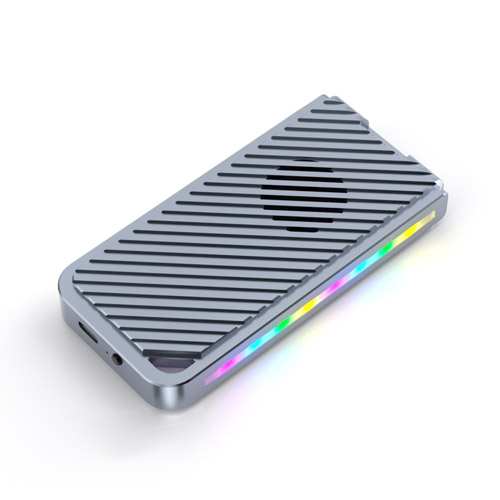
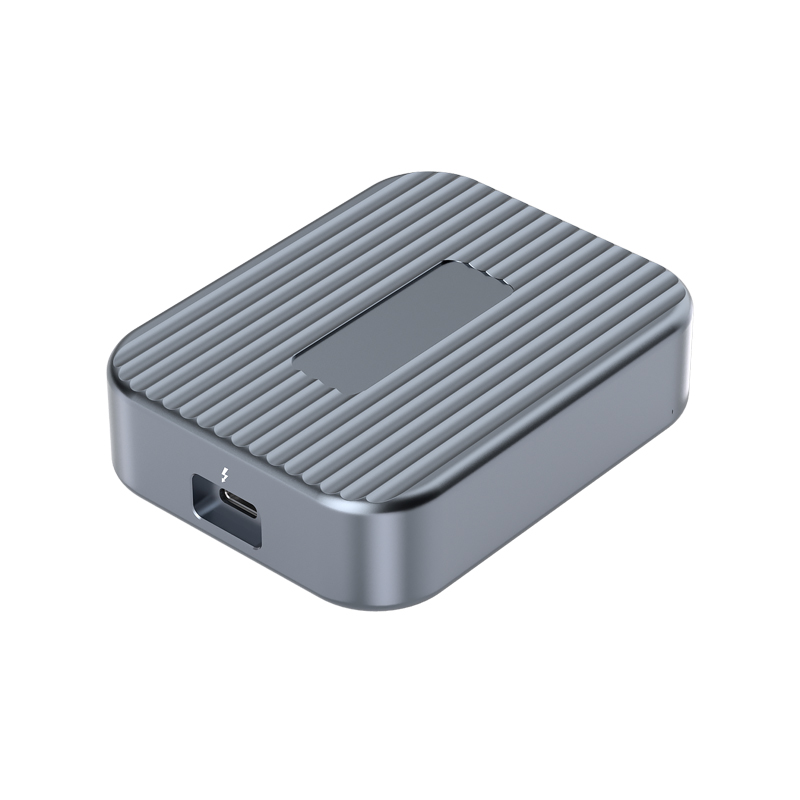
Superior industrial design requires the enclosure to feature a CNC-machined unibody aluminum alloy structure, utilizing the metal shell as a passive heatsink. In its engineering design, PURPLELEC emphasizes strict tolerance control for the interface between thermal silicone pads and the casing, and introduces wave-shaped heat dissipation fins to increase the heat exchange surface area. For future Thunderbolt 5 Enclosures, where doubled bandwidth brings higher heat generation, integrating silent active cooling fans within compact spaces is being considered to ensure sustained full-speed operation under long-term loads.
III. Signal Integrity and Physical Interface Structure
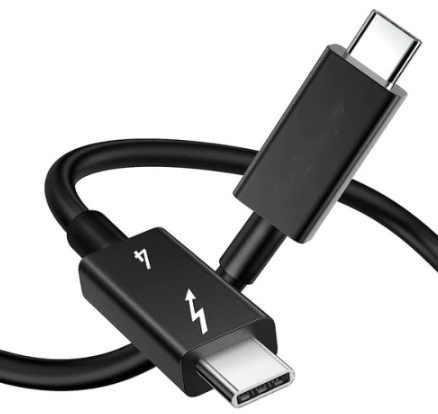
Micro-perturbations in physical connections are often the culprit behind "interface looseness" and instantaneous disconnects. In high-frequency signal transmission—such as the 40Gbps of Thunderbolt 4 or the anticipated 80Gbps/120Gbps of Thunderbolt 5 Enclosures—the Type-C interface is not merely a mechanical connection point but the bottleneck of signal transmission.
Low-cost solutions often use simple direct-plug soldering, which lacks mechanical strength; solder joints fatigue and crack after repeated plugging and unplugging. High-standard B2B manufacturing specifications require the use of mid-mount (sunk-plate) or fully enclosed reinforced soldering processes, alongside rigorous impedance matching tests for cables. This ensures that even with slight dragging or cable bending, the differential signal lines maintain stable contact resistance, preventing link loss caused by Eye Pattern closure.
IV. Future Interface Standards: Thunderbolt 5 and USB4
As bandwidth demands grow exponentially, storage peripherals are in a transition window from Thunderbolt 3/4 to the next generation of standards. The Thunderbolt 5 Enclosure, representing the next generation of high-performance storage, will rely on PAM-3 (Pulse Amplitude Modulation 3-level) technology to provide up to 80Gbps of bidirectional bandwidth.
This places higher demands not only on the controller chip but also on the dielectric constant of PCB materials and the design of trace shielding layers. As a manufacturer deeply rooted in the foreign trade B2B sector, PURPLELEC has already laid out R&D shielding solutions against high-frequency Electromagnetic Interference (EMI), aiming to provide OEM clients with ultimate storage solutions perfectly adapted to future Mac releases.
Conclusion
The stability of external storage is not metaphysics; it is a comprehensive manifestation of materials science, thermodynamics, and electronic engineering. For professional users and commercial clients pursuing ultimate data safety, choosing a Thunderbolt Enclosure that has undergone strict signal integrity testing and thermal design validation is the foundation of workflow continuity. In the wave of technological evolution, the technical reserves of hardware manufacturers will directly determine the data safety experience of the end user.