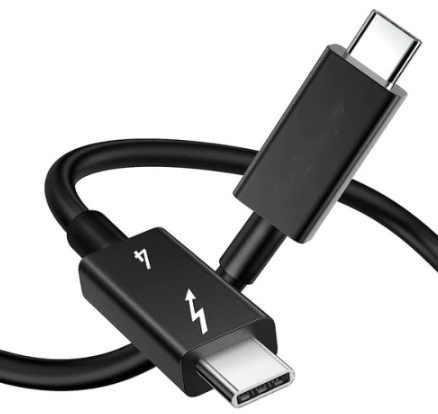
In today's data-driven era, choosing the right connectivity technology is crucial for improving work efficiency and device performance. Thunderbolt 5 and USB4, as the two giants in the field of connectivity, each have their own strengths in speed, compatibility, and performance. This article will delve into the core differences between these two technologies, helping you make informed choices based on your own needs.
Thunderbolt 5: The pinnacle of connectivity technology
Thunderbolt 5, as Intel's latest generation of connectivity technology, stands out with its amazing data transfer rate and outstanding performance. It provides a basic data transmission rate of up to 80 Gbps and can soar to 120 Gbps with bandwidth boosting technology, making it easy to handle high load tasks such as large datasets and high-resolution video editing.
In addition to its speed advantage, Thunderbolt 5 also supports multiple high-resolution displays, such as three 144Hz 4K displays or two 60Hz 8K displays, providing content creators, gamers, and professionals with the ultimate visual experience. In addition, Thunderbolt 5 has powerful power supply capabilities, providing up to 240W of charging power to meet the charging needs of various devices. At the same time, it is also backward compatible with Thunderbolt 3, Thunderbolt 4, and USB4 devices, ensuring seamless use of existing peripheral devices.
USB4: A Major Leap in the USB Ecosystem
USB4 represents another major upgrade to the USB ecosystem, integrating the features of the Intel Thunderbolt 4 standard, significantly improving speed and efficiency. USB4 V1 supports data transfer rates of up to 40Gbps, while USB4 V2 doubles the speed to 80Gbps, making it flexible and suitable for various application scenarios.
USB4 adopts a reversible USB-C interface, simplifying the device connection process. It can also provide up to 240W of power output for efficient charging of laptops and other devices. In addition, USB4 supports connecting dual 4K displays or single 8K displays through a single cable, meeting the needs of modern high-resolution devices. More importantly, USB4 is backward compatible with all early USB versions, including USB 3.2, USB 2.0, Thunderbolt 3 and 4, as well as previous versions, ensuring continuous use of existing and peripheral devices.
Thunderbolt 5 and USB4: Core Differences Analysis
Data transmission speed and bandwidth
Thunderbolt 5 has a significant advantage in data transfer speed, reaching up to 120 Gbps, far higher than USB4's 80 Gbps (although USB4 2.0 also supports 80 Gbps, most devices on the market still follow the 40 Gbps standard). This speed difference makes Thunderbolt 5 more suitable for tasks that require high-speed data transfer, such as 8K video streaming or large dataset transfer.
Power transmission capacity
In terms of power supply, both Thunderbolt 5 and USB4 perform well, supporting up to 240W of power output. However, the Thunderbolt 5 specification requires a minimum charging power of 140W, while USB4 does not have such a clear requirement. This makes Thunderbolt 5 more suitable for charging high power consuming devices and meeting the requirements of the highest power standards in the future.
External display and video output support
Thunderbolt 5 is at the forefront of high-resolution displays and video output support. It supports the connection of multiple high-resolution displays and has a refresh rate support of up to 540Hz, bringing the ultimate visual experience to gamers and professionals. USB4 supports dual 4K displays or single 8K displays through a single cable, meeting the needs of general users.
Compatibility and backward compatibility
Thunderbolt 5 and USB4 both demonstrate excellent compatibility. Thunderbolt 5 is fully compatible with Thunderbolt 4, Thunderbolt 3, USB4, and USB-C devices, ensuring seamless use of existing peripheral devices. USB4 is backward compatible with all early USB versions and Thunderbolt 3 devices, providing users with a wider range of device support.
Practical application and selection suggestions
In practical applications, Thunderbolt 5 significantly improves the efficiency and performance of professional workflows, especially suitable for high load tasks such as game development, 3D animation, and visual effects rendering. USB4, on the other hand, meets daily usage needs with its affordability and versatility.
For users who pursue ultimate performance and are future oriented, Thunderbolt 5 is the ideal choice. It offers speeds of up to 120 Gbps and outstanding performance, meeting the demands of high demand applications. For users with low demand and seeking affordable solutions, USB4 is a good choice. It integrates Thunderbolt 4 functionality and has backward compatibility, providing a multifunctional and cost-effective solution for daily use.
New cables and accessories: unleashing technological potential
To fully unleash the potential of Thunderbolt 5 and USB4, appropriate cables and accessories are crucial. Thunderbolt 5 cables are compatible with Thunderbolt 4 and feature a more flexible design for reliable signal communication. The USB4 cable provides excellent performance, with a minimum transmission speed of up to 20 Gbps, suitable for various applications.
Conclusion
Thunderbolt 5 and USB4, as the two giants of connectivity technology, each have unique advantages. Thunderbolt 5 is an ideal choice for demanding applications due to its unparalleled data transfer speed, power supply capability, and support for high-resolution displays. USB4, on the other hand, meets daily usage needs with its versatility and cost-effectiveness. Choosing the appropriate technology depends on your specific needs and considerations for the future. No matter which technology you choose, it will bring new heights of innovation and efficiency to your connectivity experience.