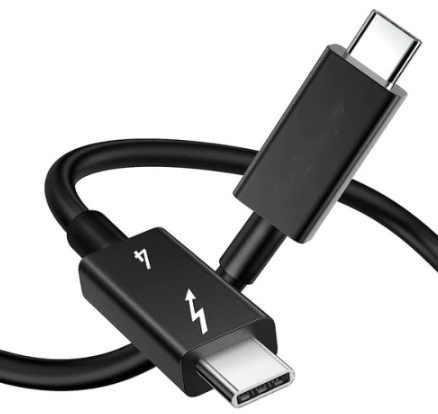
As Intel’s latest high-speed connectivity technology, Thunderbolt 5 redefines device interconnection with disruptive bandwidth upgrades and multi-functional integration. This guide delves into its core technical features, compares it with previous generations and USB-C, explores real-world applications in professional creativity, esports gaming, and multi-screen workplaces, and provides dock selection tips to help you seize the opportunities of the next connectivity revolution.
I. Thunderbolt 5 Core Technology: Dual Leap in Speed and Functionality
(A) Bandwidth Performance: From Doubling to Breaking Through
Baseline Transfer Rate: 80 Gbps bi-directional bandwidth (40 Gbps for Thunderbolt 4), capable of transferring 100GB video files in 10 seconds.
Dynamic Bandwidth Boost: For heavy workloads like video rendering and external GPU use, peak bandwidth reaches 120 Gbps—3x faster than USB4 (40 Gbps).
(B) Display and Power Delivery: Professional-Grade Expansion
Multi-Display Support: Connects up to 3×4K@144Hz or 2×8K@60Hz monitors, a generational upgrade from Thunderbolt 4’s 2×4K or 1×8K support.
Enhanced Power Delivery: 240W power output (100W for Thunderbolt 4), capable of directly charging 18-inch gaming laptops or dual-screen docks, reducing redundant power adapters.
(C) Protocol Integration and Compatibility
Multi-Protocol Convergence: Built on USB4 V2, DisplayPort 2.1, and PCIe 4.0, it’s backward-compatible with USB-C/Thunderbolt 3/4 devices and supports direct HDMI 2.1/DP 2.1 connectivity.
Signal Technology Innovation: Uses PAM-3 encoding to achieve full-speed transmission over 1-meter passive cables, eliminating the need for expensive active cables.
II. Thunderbolt 5 vs. Thunderbolt 4 vs. USB-C: Key Dimension Comparison
| Dimension |
Thunderbolt 5 |
Thunderbolt 4 |
USB-C (USB4) |
| Bi-Directional Bandwidth |
80 Gbps (120 Gbps peak) |
40 Gbps |
40 Gbps |
| Multi-Display Support |
3×4K@144Hz / 2×8K@60Hz |
2×4K@60Hz / 1×8K@60Hz |
2×4K@60Hz |
| Maximum Power Delivery |
240W |
100W |
100W |
| PCIe Lanes |
4×4.0 (64 Gbps) |
4×3.0 (32 Gbps) |
Variable (up to 4×4.0) |
| Typical Applications |
8K editing/3-screen esports/240W charging |
Dual 4K office/100W charging |
External SSD/single-screen expansion |
Core Difference: Thunderbolt 5’s comprehensive leadership in bandwidth, power, and protocol integration makes it the sole choice for professional scenarios, while USB-C suits lightweight needs.
III. Analysis of Four Core Use Cases
(A) 8K Video Creation and Live Streaming
Performance Requirement: 8K RAW video requires over 2GB/s data throughput, needing 100+ Gbps bandwidth for real-time editing.
Thunderbolt 5 Solution:
External NVMe RAID arrays (64 Gbps PCIe 4.0) achieve 7000MB/s sustained read/write speeds.
Simultaneously drives 2×8K monitors + 1×4K control screen, supporting DaVinci Resolve multi-node color grading.
Case Study: A film studio using a Thunderbolt 5 dock to connect an 8K camera, SSD array, and dual monitors saw a 40% rendering efficiency boost.
(B) Esports-Level Multi-Screen Gaming Experience
Key Metrics: 540Hz refresh rate monitors require 120Gbps bandwidth; external RTX 4090 docks bring laptop performance close to desktops.
Scenario Implementation:
Three-screen surround racing simulation (3×4K@144Hz) with<5ms latency.
Laptop + eGPU runs Cyberpunk 2077 with Ray Tracing maxed at 120FPS.
Pro gamers using Thunderbolt 5 docks to connect tactical displays and macro keyboards see 15% faster response times.
(C) Enterprise-Level Multitask Workstations
Efficiency Logic: 240W power + triple-display output + 20Gbps internal networking simplifies IT deployment.
Typical Configurations:
Financial analysts run Bloomberg Terminal, Excel dashboards, and video conferences (3×4K@60Hz).
Development teams build temporary rendering clusters via Thunderbolt networking, achieving 2500MB/s file transfers.
Hospital radiology departments connect 4K diagnostic screens and PCIe SSD arrays for real-time 3D medical image review.
(D) Mobile Productivity Extreme Expansion
Laptop Full Potential: Thin laptops with Thunderbolt 5 can connect to GPU docks, dual 8K screens, and 10Gbps drives, becoming mobile workstations.
Setup Example:
14-inch laptop (Thunderbolt 5) + Anker Prime Dock.
Transfers 10GB files in 8 seconds—16x faster than USB-C (5Gbps).
Supports 180W charging while outputting dual 8K video, ideal for live directing or outdoor streaming.
IV. Dock Selection Guide: Unleashing Thunderbolt 5’s Full Potential
(A) Core Parameter Priorities
Bandwidth Support: Ensure "Thunderbolt 5" or "120Gbps" labeling to avoid confusing USB4 products.
Interface Configuration:
Video Output: At least 1×DP 2.1 + 1×HDMI 2.1 for 8K@60Hz support.
Storage Ports: Dedicated USB4/Thunderbolt ports (blue 标识) for NVMe compatibility.
Power Capacity: 240W input, supporting laptop PD charging + peripheral power distribution.
1. Performance Highlights
120Gbps Full-Speed Transfer: 50GB video transferred in 42 seconds (USB4: 1m24s).
Triple 8K Output: 2×DP 2.1 + 1×HDMI 2.1 supports 2×8K@60Hz + 1×4K@144Hz.
240W Universal Power: 100W for laptop charging, 140W remaining for GPU docks/hard drives.
2. Scene Adaptation
Creators: Connects BMPCC 6K Pro, OWC Thunderbay 4, and dual LG UltraFine 32UL950 displays.
Gamers: Dock→RTX 4090 GPU dock→3×ROG Swift PG27AQN (2K@240Hz) for 480Hz total refresh.
Professionals: Single-cable connection to laptop, 4K projector, and 10Gbps NAS for hot-swappable meeting setups.
3. Purchase Tips
Pitfalls to Avoid: Skip "USB-C 40Gbps" docks that can’t utilize Thunderbolt 5’s bandwidth.
Long-Term Investment: Prioritize actively cooled models (e.g., Anker’s silent fan) for sustained heavy loads.
V. Future Trends and User Decision-Making
(A) Technological Evolution
Fiber Optic Cables: Thunderbolt 5 fiber cables (2024) may enable 10-meter transmission.
AI Compute Expansion: Thunderbolt 5 docks with integrated NPUs for external AI acceleration in video generation.
(B) Upgrade Decision Guide
Immediate Upgraders:
8K/VR creators, esports pros, multi-screen financial analysts.
Users on Thunderbolt 3/4 needing to surpass dual 4K limits.
Wait-and-See:
Casual users with single 4K screens or basic external drives.
Light users on non-Thunderbolt USB-C laptops with low power needs.
Action Advice: If upgrading to 8K monitors, RTX 50-series GPUs, or professional storage in the next 3 years, pre-invest in Thunderbolt 5 docks to future-proof against interface obsolescence.
Conclusion: Defining the Next Generation of Connectivity
Thunderbolt 5 is more than a tech upgrade—it’s a workflow engine for professional fields. From real-time 8K video editing to millisecond-level esports responses and enterprise multi-screen collaboration, its 120Gbps bandwidth and 240W power are breaking device performance barriers. For users chasing extreme productivity and experiences, adopting Thunderbolt 5 means stepping into a future where "one cable drives it all." Upgrade now and future-proof your device ecosystem!