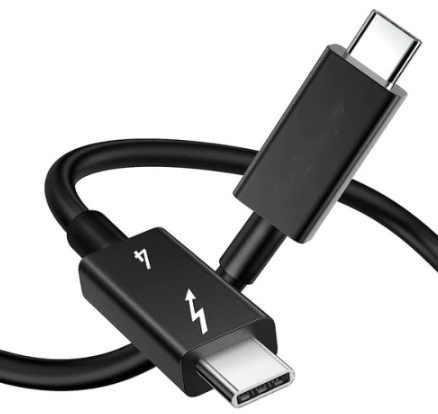
You may have noticed that the common USB Type-A ports (abbreviated as USB-A) are gradually disappearing from the mobile phones, tablets, and even laptops that you purchase nowadays, being replaced by USB Type-C ports (abbreviated as USB-C).
The Rise of USB-C: A New Type of Connector
USB-C is a new type of connector designed for data transfer and power supply between various computing devices. Its plug features a symmetrical design, allowing for insertion in either direction, on par with Apple's Lightning interface. However, the widespread popularity of USB-C is not solely due to this convenient design. It is also closely related to emerging and powerful technologies such as USB Power Delivery, Thunderbolt 3, and USB 3.1.
The old version of USB-C ports is based on the USB 3.1 data transfer standard, with a speed of up to 5 Gbps. The second-generation USB-C ports, also known as SuperSpeed ports, claim a transfer speed of up to 10 Gbps. For computers that support Thunderbolt, USB-C, with the help of Intel's Thunderbolt 3 technology, can theoretically reach a data transfer speed of up to 40 Gbps.
Why Should We Pay Attention to USB-C's New Data Transfer Technologies?
For the first time ever, we can achieve a sufficiently high data transfer speed to stream high-resolution video content via a USB connection. The Alternate Mode (Alt Mode) of USB-C enables adapters to output video from USB ports to common video interfaces such as DisplayPort, HDMI, and VGA, connecting to various displays like TVs and projectors.
Moreover, thanks to the USB Power Delivery function, USB-C ports can power laptops. USB 2.0 ports can only provide 2.5 watts of power, which is just enough to charge a mobile phone at a very slow speed. USB 3.1 increases the power to 15 watts, equivalent to a so-called "fast mobile phone charger". USB PD promises to deliver 100 watts of power, more than six times that of USB 3.1, making it possible to power laptops and peripheral devices such as projectors. However, to use these functions and fully leverage USB-C ports, you still need to purchase some accessories.
Transmitting High-Resolution Video via USB-C
Before proceeding further, you need to purchase a USB-C hub, such as NovaHUB, which allows you to switch to connections with various devices as needed. When choosing a hub, prioritize DisplayPort as it is specifically designed for high-resolution video output. Although the HDMI port is more familiar, DisplayPort offers a higher refresh rate (Hz) and resolution. Additionally, compared with HDMI, DisplayPort can transmit video content more efficiently through a USB-C connection under similar refresh rate and resolution conditions.
How USB-C Transmits Video
The USB-C connector has four differential pairs (channels) for high-speed data transfer. USB 3.2 Gen 2 uses only two of these four channels, leaving the other two idle. These two idle channels can be repurposed to transmit native DisplayPort signals through the Alt Mode function of USB-C without compromising the performance of USB 3.1.
With these two channels, there is enough bandwidth to transmit to an external display at a 4k 30 Hz refresh rate. This is acceptable for watching movies, but the experience on a Windows desktop or macOS can be frustrating. To maintain a 60 Hz refresh rate, the resolution must be reduced to 2k or lower. To achieve 4k@60 Hz, 5K, or connect multiple external displays, you need to use the DisplayPort Alt Mode and dedicate all four channels to DisplayPort data. In this case, the computer and external display will still show a regular DisplayPort connection, but there will be no room for USB 3.1 data storage. One of the only ways to solve this problem is to purchase a Thunderbolt 3 hub, which can be expensive, and your computer must support Thunderbolt 3.
Why Choose Purplelec HBC074
HBC074 is one of the most powerful portable USB-C hubs on the market. This single-interface hub can output a resolution of 4k@60Hz, which is extremely rare among similar products, as explained above.
HBC074 integrates a USB 3.0 Gen 1 chipset, with both USB-A and USB-C ports offering a data transfer speed of 5 Gbps. The second USB-C port can provide 100 watts of power, easily powering even the most power-hungry laptops on the market and ensuring that your laptop remains fully charged during use.
It is equipped with a Gigabit Ethernet port (10/100/1000) for uninterrupted LAN connectivity, a dedicated slot for convenient SD card data transfer, and a flat cable design to prevent damage to the connector and hub.
The body of HBC074 is made of aluminum, making it lightweight, portable, and durable, with compact dimensions of only 100 x 100 x 20 mm. It features the following ports:
.Two USB-A ports with a transfer speed of 5 Gbps
.One USB-C port for USB power supply
.One USB-C port with a transfer speed of 5 Gbps
.One HDMI port supporting 4k@60 Hz
.One Gigabit Ethernet port (10/100/1000)
.One SD 3.0 slot
Using HBC074, you can mirror or extend your laptop screen to a 4k resolution device without compromising video output quality.
Conclusion
If you work in fields such as design, photography, or videography, where the size and resolution of displays are crucial for performance, using USB-C ports to mirror your work screen can help improve work efficiency. Even if you just want to watch videos on a larger and better screen, you will enjoy the versatility and ease of use of a USB-C hub like HBC074.