By PURPLELEC | 04 August 2025 | 0 Comments
USB4: 80Gbps Speed Ushers in a New Era of High-Speed Connectivity Transformation
USB4, the latest iteration of the Universal Serial Bus (USB) standard, has been meticulously crafted by the USB Implementers Forum (USB-IF). Its original design goal is to outperform its predecessors, delivering faster, more efficient, and far more powerful performance. It is compatible with a wide range of standards, including Thunderbolt 3, DisplayPort, as well as USB 2.0, 3.2, and 4, making it the most feature-rich USB standard to date.
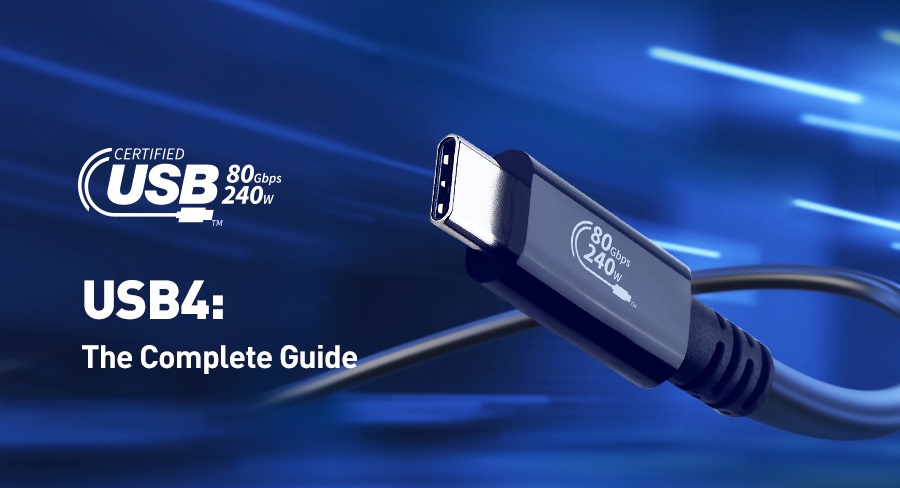
80Gbps: A Quantum Leap for USB4
The most striking feature of USB4 is its remarkable upgrade in transmission speed to 80Gbps, a doubling compared to the previous generation. This breakthrough is attributed to Intel's Thunderbolt 4 technology, on which USB4 is based. By integrating 40Gbps links, USB4 achieves a maximum speed of 80Gbps, far surpassing the peak speed of 20Gbps offered by USB 3.2.
USB4 vs. Previous Generations
Looking back at the evolution of USB, USB 1.0, released in 1996, had a maximum speed of just 12Mbps. USB 2.0, launched in 2000, significantly increased this to 480Mbps. USB 3.0, introduced in 2008, further boosted the speed to 5Gbps, while USB 3.2, released in 2017, reached a maximum of 20Gbps.
In contrast, USB4 stands out with its 80Gbps speed, marking a substantial improvement over its predecessors. It is four times faster than USB 3.2 and sixteen times faster than USB 2.0. This significant speed enhancement enables smoother and more seamless operation of high-bandwidth applications such as video editing and gaming.
Why USB4 is Revolutionizing High-Speed Connectivity
The upgrade of USB4 to 80Gbps brings about transformative changes in high-speed connectivity for several reasons. Firstly, it allows for the lightning-fast transfer of large files, such as 4K videos, within seconds. This greatly facilitates content creators in swiftly moving their works. Secondly, it ensures the smooth transmission of high-quality video and audio without buffering or latency issues. This elevates the quality of video conferencing and online gaming, making them feel more like face-to-face interactions. Lastly, USB4's compatibility with multiple USB standards showcases its versatility and future-proof nature. As technology advances, USB4 can keep pace, making it a worthwhile investment.
Conclusion
In conclusion, the upgrade of USB4 to 80Gbps represents a significant leap forward compared to its predecessors and is set to revolutionize high-speed connectivity. Its exceptional speed and versatility make it easier and faster to transfer large files, play high-quality video and audio, and utilize high-bandwidth applications. Moreover, its compatibility with various USB standards ensures its future-readiness, making it a smart investment. As our reliance on technology continues to grow, the timing of USB4's upgrade to 80Gbps couldn't be more opportune.
USB4 vs. Thunderbolt 3: A Head-to-Head Comparison of Connection Standards - Which One Reigns Supreme
DisplayPort: The Performance Leader and Evolution Path in the Digital Interface Field
Leave a Reply
Your email address will not be published.Required fields are marked. *