By PURPLELEC | 12 March 2026 | 0 Comments
Broadcast-Grade Full HD Video Capture Card: Technical Specs & Selection Guide
In the field of digital video transmission and processing, hardware stability and signal capture precision directly determine the final image quality. As the core hardware of audio-video system integration, the broadcast-grade full HD video capture card is responsible for the critical task of converting external physical signals into high-quality digital data streams. Whether applied in rigorous industrial image analysis or high-frequency commercial video conferences, premium video capture hardware provides indispensable underlying support.
This guide will deeply analyze the core operating logic of full HD video capture cards across three dimensions: technical parameters, interface architecture, and software ecosystem.
1. Core Image Processing and Resolution Support
When capturing video, balancing frame rate and resolution is the primary standard for measuring hardware performance. Standard broadcast-grade capture devices typically possess robust raw signal processing capabilities:
Lossless Full HD Capture: The device supports native HDMI signal capture, achieving smooth video input up to 1080p at 30 frames per second (fps). This specification effectively controls video stream bandwidth consumption while maintaining pristine image detail and clarity.
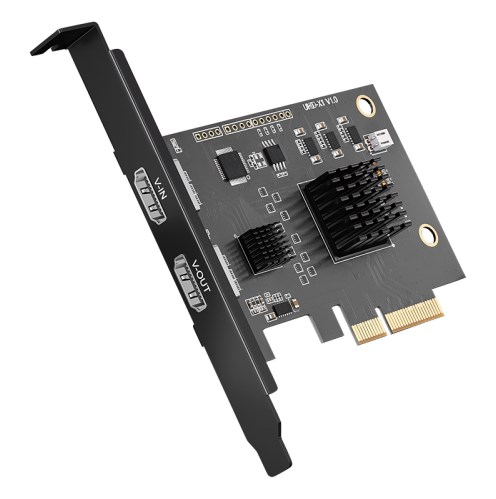
Broad Format Compatibility: When interfacing with various front-end devices (e.g., HD cameras, medical endoscopes, HD set-top boxes), professional capture hardware can automatically adapt to multiple video specifications. It supports standard definition (SD) and high definition (HD) interlaced/progressive formats, including 1080 30p/50i/60i, 720 50p/60p, and 576/480.
PC Display Adaptation: On the output end, the hardware seamlessly matches mainstream monitor resolutions (such as 1920x1200, 1680x1050, 1280x1024, and 1024x768), ensuring real-time previews without image distortion or scaling artifacts.
2. Heterogeneous Multi-Interface Array and Concurrency
Complex engineering environments often require compatibility with both legacy and modern video standards. An advanced full HD capture card (such as the typical C729 architecture) must feature high backward compatibility and horizontal scalability in its interface design:
Comprehensive Interface Coverage: Beyond mainstream HDMI and DVI high-definition digital interfaces, numerous analog signal devices still exist in the industrial and medical sectors. Therefore, integrating 1080i analog component, S-Video, and composite video inputs is crucial for meeting diverse industry demands.
Synchronous Signal Processing: The hardware architecture allows for the simultaneous capture of both HD and SD signals, significantly improving the efficiency of mixing and routing multiple signal sources.
Multi-Card Concurrent Operation: In large-scale monitoring matrices or multi-camera live streaming scenarios, a single workstation often needs to process massive video streams. Supporting the parallel installation and simultaneous operation of multiple capture cards on the same motherboard is a critical indicator of underlying driver stability.
3. Underlying Protocol Compatibility and Software Ecosystem
Hardware performance relies heavily on extensive software support. For system integration and streaming distribution, protocol universality is paramount:
Native DirectShow Architecture Support: Following the Microsoft DirectShow underlying API means the device can be directly recognized by the vast majority of mainstream video editing and streaming software without requiring low-level driver adaptation.
Mainstream Productivity Tool Compatibility: Whether for post-production non-linear editing (like Adobe Premiere Pro CS5) or real-time streaming encoding and broadcasting (like Adobe Flash Media Live Encoder, VLC Media Player, AMCap, and Microsoft Media Encoder), plug-and-play functionality is guaranteed.
SDK Secondary Development Empowerment: For enterprise clients with customized application needs, supporting secondary development based on a standard API SDK (Software Development Kit) provides immense added value. This allows the capture card to be seamlessly embedded into medical imaging analysis systems, enterprise cloud conference terminals, and educational recording servers to accomplish professional, high-quality video scheduling.
Conclusion
From simple signal conversion to complex systematic data stream management, the technological iteration of conference capture cards and broadcast-grade capture equipment is driving the professionalization of video applications across all industries. When selecting hardware, system integrators and procurement teams must comprehensively consider the interface complexity of front-end devices, the protocol standards of back-end software, and future requirements for concurrent expansion.
Purplelec PEC-4HDMI Medical industry dedicated video capture card
two-channel High-definition HDMI+SDI audio and video capture card
Leave a Reply
Your email address will not be published.Required fields are marked. *