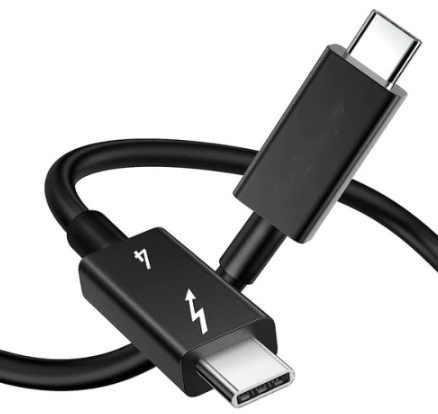
When Thunderbolt 5 was introduced, many users had a question in their minds: can this new high-speed connectivity technology be compatible with existing devices, allowing us to enjoy the convenience brought by the new technology without having to replace old devices? Thunderbolt 5, with its extremely fast speed, powerful performance, and seamless integration, has become the focus of attention for many technology enthusiasts. Next, we will delve into its functions, how it works with existing devices, and the reasons why it is worth upgrading.
Thunderbolt 5: Defining New Heights in High Speed Connectivity
Thunderbolt 5 is a major breakthrough in the field of high-speed connectivity, designed to meet the demanding digital demands of today and even the future. It doubles PCIe bandwidth, significantly improving external storage and network transfer speeds. Whether it's the smooth experience pursued by gamers or the demand for efficient processing by video editors, Thunderbolt 5 can bring disruptive changes. This technology integrates USB4 2.0 and DisplayPort 2.1, further enhancing display and data tunneling capabilities.
The advantages of Thunderbolt 5 are reflected in multiple aspects:
Speed leap: Provides 80Gbps bidirectional bandwidth, twice the previous generation's 40Gbps bandwidth. Under special configuration, with the help of bandwidth enhancement function, its unidirectional bandwidth can even reach up to 120Gbps.
Strong power supply: The power transmission capacity can reach up to 240W, and a single cable can charge power consuming devices such as laptops and workstations.
Display upgrade: Supports up to three 144Hz 4K displays, two 60Hz 8K displays, and even a single 10K screen, meeting the needs of multiple display settings and ultra-high resolution display.
Technological innovation: PCIe Gen 4 is used to achieve faster data channels, USB4 v2 is used to achieve wider compatibility, and all interfaces are unified as USB-C. Simultaneously introducing PAM-3 modulation technology to reduce latency and improve transmission efficiency.
Security guarantee: Advanced security protocols, such as integrated direct memory access (DMA) protection mechanism based on Intel VT-d, safeguard data transmission.
Compared with Thunderbolt 4, Thunderbolt 5 has achieved significant improvements in bandwidth, power supply, and display performance, not only keeping up with the trend of technological development, but also constantly breaking through itself.
Seamless compatibility: Thunderbolt 5 collaborates with existing devices
One of the highlights of Thunderbolt 5 is its powerful compatibility, making it easy to use without discarding old devices. It is fully backward compatible and can seamlessly integrate with existing devices from Thunderbolt 3 docking stations to USB-C hard drives, enhancing their bandwidth and speed.
Thunderbolt 4 devices
If you have a Thunderbolt 4 hub, cable, or solid-state drive, simply plug it into a Thunderbolt 5 port and it will work properly, enjoying Thunderbolt 4's 40Gbps speed and power transfer. At the same time, the additional bandwidth of Thunderbolt 5 can slightly improve the performance of existing devices when multiple devices are used simultaneously.
Thunderbolt 3 devices
Thunderbolt 5 and Thunderbolt 3 devices can also seamlessly connect. External GPUs, SSDs, or docking stations purchased a few years ago can run at Thunderbolt 3's maximum 40Gbps speed and support power transfer. Although older devices cannot achieve a speed of 80Gbps, Thunderbolt 5's improved data processing capabilities can still accelerate file transfer speeds and reduce latency.
USB-C ports and devices
Due to its USB-C interface, Thunderbolt 5 is compatible with any USB-C device. However, if the laptop is equipped with a standard USB-C interface (not Thunderbolt), the speed when connecting Thunderbolt 5 accessories will be limited by the port, such as USB 3.2 Gen 2 typically at 10Gbps and USB 3.2 Gen 2x2 at 20Gbps. In addition, some USB-C ports do not support video output, and the port specifications need to be checked before use.
Compatible with USB4
Thunderbolt 5 integrates USB4 2.0 and DisplayPort 2.1 standards, supporting USB transfer rates of up to 80Gbps, while maintaining backward compatibility with existing USB4 and DisplayPort devices, providing high-speed data transfer and enhanced display performance.
It should be noted that although Thunderbolt 5 supports older devices, the performance of these devices is still limited by their original specifications and cannot fully utilize all the enhanced features of Thunderbolt 5. For example, the maximum speed of Thunderbolt 3 SSD is still 40Gbps.
Cable selection: unleashing the full potential of Thunderbolt 5
The performance of Thunderbolt 5 cannot be achieved without suitable cables:
Thunderbolt 5 cable: To achieve speeds of 80Gbps (or 120Gbps with bandwidth boost enabled), a Thunderbolt 5 certified cable is required. This type of cable is designed for high speed and high power (up to 240W), with Thunderbolt logo and "5" logo on the packaging.
Thunderbolt 4 cable: Existing Thunderbolt 4 cables are compatible with Thunderbolt 5 devices, but only support speeds of up to 40Gbps, which cannot fully leverage the performance advantages of Thunderbolt 5.
Passive and active cables: Passive cables are available for short distance connections (within 2 meters), with lower prices and higher reliability; Long distance connections require active cables with integrated microcircuits that can maintain signal strength and meet the requirements of long-distance 80Gbps transmission or large multi display configurations.
USB4 cable: USB4 cable is compatible with Thunderbolt 5 devices, but there are performance differences. The certified USB4 cable can reach a speed of 40Gbps, and the USB4 2.0 version can reach a speed of 80Gbps, but some cables only support 20Gbps.
USB-C cable: Although universal USB-C cables can be connected, most of them have a speed limit of 10Gbps or lower and are only suitable for charging or connecting basic USB devices.
If Thunderbolt 3 or 4 devices are still being used, the existing cables can basically meet the needs; If you want to experience the high-speed performance of Thunderbolt 5, it is recommended to purchase certified Thunderbolt 5 cables from brands such as Cable Matters (over 2 meters).
Upgrade Thunderbolt 5: Embark on an efficient and convenient new experience
The value of Thunderbolt 5 is not only reflected in its performance, but also brings many conveniences to users:
Efficient workflow: With speeds of 80Gbps or even 120Gbps, transferring 100GB video files takes only a few seconds, allowing video editors to smoothly process 8K materials in real-time.
Stunning display effect: Supports the connection of multiple high-resolution displays, whether it's three 144Hz 4K screens for editing and gaming, two 60Hz 8K HDR displays, or a 10K display bringing a wide field of view, all can be easily achieved.
Single line universal connection: A Thunderbolt 5 cable can charge a laptop (up to 240W) while providing power to both the monitor and drive, eliminating the hassle of cables and power adapters.
Excellent gaming experience: Paired with an external GPU and 540Hz monitor, low latency and high bandwidth ensure smooth gaming even at extremely high refresh rates.
Thunderbolt 5 is an innovator in the field of high-speed connectivity, which not only keeps Thunderbolt 3 and 4 devices running smoothly, but also provides users with a single wire solution with a transfer speed of 80Gbps, 240W power, and powerful multi screen display capabilities. Whether you are a content creator, gamer, or ordinary user, Thunderbolt 5 can enhance the performance of existing devices and open up a more efficient and convenient future device usage experience.