By PURPLELEC | 03 June 2025 | 0 Comments
USB-C PD: The Next-Generation Charging Technology
USB-C offers numerous advantages, from its reversible design to its compact size. However, what truly makes it so popular is its ability to rapidly charge supported devices, such as the iPhone X. This is made possible by a technology called USB-C Power Delivery (USB-C PD). USB-C PD represents a significant leap forward in charging technology, meeting the demand for fast, efficient, and universal solutions to power a wide range of electronic devices.
The rise of USB-C PD reflects the technology industry's trend towards simplification and standardization. With a single USB-C PD-compatible charger, you can charge your smartphone, tablet, or even laptop, eliminating the need for multiple chargers and reducing cable clutter.
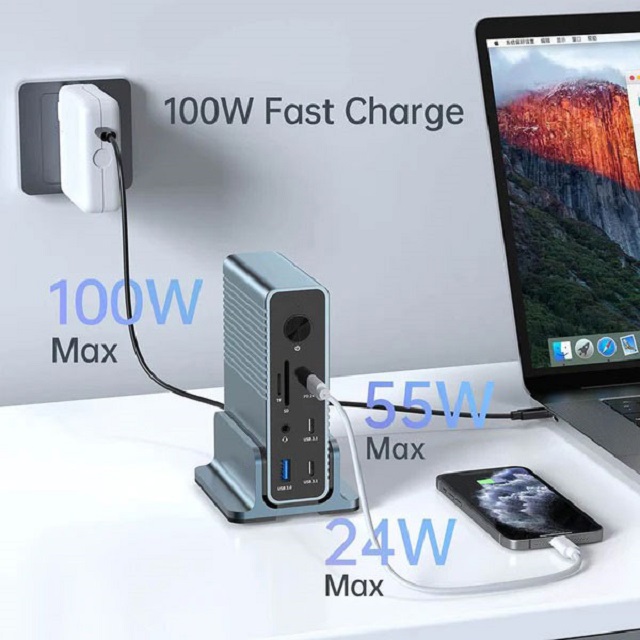
In this article, we will delve into how USB-C Power Delivery works, its advantages over older charging methods, and why it is increasingly being adopted as the preferred choice for powering electronic devices today.
What Is USB-C Power Delivery?
USB-C Power Delivery is the latest and most powerful USB charging technology, capable of providing faster charging speeds for a wide range of devices.
How Does USB-C Power Delivery Work?
USB-C Power Delivery is an advanced charging technology that leverages the capabilities of the USB-C connector to deliver higher power to devices more efficiently than standard charging methods. Unlike traditional charging, USB-C PD supports bidirectional power exchange between the device and the charger. This "conversation" enables adaptive power delivery, providing the precise amount of power needed at any given time. This system allows devices like smartphones, laptops, and tablets to charge faster and also supports larger devices that require more power. Here's a detailed look at how USB-C Power Delivery operates:
1. Dynamic Power Adjustment
One of the key features of USB-C PD is its ability to dynamically regulate power transmission between the charger and the device. This is managed through a protocol that communicates the optimal power level required at any given time between the device being charged and the power source. This communication ensures that the device only draws the power it needs and can handle, optimizing charging efficiency and safety.
2. Increased Power Levels
USB-C PD significantly boosts the power delivery capabilities of USB connections. While standard USB 2.0 connections can provide up to 2.5 watts and USB 3.0 up to 4.5 watts, USB-C PD can deliver up to 240 watts. This power level is sufficient to charge larger devices, such as high-performance laptops, monitors, and other high-power devices that were previously unable to be charged via USB.
3. Reversible Connector
The USB-C connector used for USB-C PD supports reversible insertion, meaning it can be plugged in either way, eliminating the common issue of incorrect USB device connections. This simple yet significant feature enhances the user experience.
4. Versatility
USB-C PD is designed to be universal, meaning it can be used across a variety of devices. It is not limited to any specific brand or device type, making it an extremely versatile charging solution. Users can charge different types of devices with the same charger, reducing the number of chargers needed.
5. Backward Compatibility
USB-C PD is backward compatible with older USB versions. This means that even if a device or charger does not support Power Delivery, they can still be used together for normal USB functionality, although they won't benefit from the faster, higher-power charging advantages of PD.
6. Safety Features
Safety is a crucial aspect of USB-C PD. The protocol includes several measures aimed at preventing issues such as overcharging, overheating, and overvoltage, which can damage devices or pose safety hazards. The advanced power management features built into USB-C PD ensure that these risks are minimized.
By integrating these features, USB-C Power Delivery offers a more powerful, efficient, and flexible charging solution than traditional USB charging, meeting the demands of today's high-performance devices. This technology continues to evolve, pushing the boundaries of USB connectivity in terms of power and performance.
The Evolution of Power Delivery
The concept behind USB Power Delivery is to provide faster charging speeds for devices capable of handling higher power. Before the advent of USB-C and Power Delivery, the maximum charging power for existing devices was 15W, with most devices not even exceeding 7.5W. This limitation was based on the mechanical design of USB cables—they simply couldn't safely handle higher power.
With the finalization of USB-C in 2014, USB cables capable of handling higher power finally emerged. USB-C features a separate configuration channel that enables power negotiation between the power source and the power sink. Power Delivery 2.0 was also released around the same time, allowing the transmission of 100W of power over a 20V connection. The key was supporting voltage configurations beyond the standard 5V and 3A—supporting higher voltages and currents is what makes USB-C PD so valuable. It's also worth noting that to support power levels exceeding 60W (20V @ 3A), electronically marked cables (eMarked) are required for safety reasons.
This was a significant advancement. Previously, most USB devices charged at no more than 7.5W (5V @ 1.5A), resulting in slow charging for smart devices and a lack of practicality for larger devices like tablets or laptops. Power Delivery was designed to change this.
It's important to note that while companies like Qualcomm had introduced their own fast chargers before Power Delivery, capable of delivering up to 18W of power to compatible smart devices, these were proprietary protocols. Power Delivery was designed as a unified standard that any device manufacturer could leverage.
What is USB-C Power Delivery 3.0?
Ethernet Technology and Network Device Selection: Splitters vs. Switches
Leave a Reply
Your email address will not be published.Required fields are marked. *